

Foreclosure Auction Risks Every Detroit Homeowner Must Know
A foreclosure auction can strip you of your home, your equity, your credit standing, and still leave you owing money afterward. The core foreclosure auction risks homeowners face are permanent loss of the property, likely loss of built-up equity, a credit-score drop that persists for years, a possible deficiency judgment if the sale price falls short of your loan balance (depending on state law and foreclosure method), and an eviction clock that starts the moment the gavel falls.
Two points to understand right now:
- Deficiency means the auction sale price was lower than what you owed. The lender can sue you personally for that gap, and in many states they can garnish wages or levy your bank account to collect it.
- Credit impact is not a short-term setback. Federal Reserve research found that credit scores can remain 50–75 points below expected levels even more than seven years after a foreclosure, pushing many borrowers into subprime territory long after the event.
Start these steps within 24–72 hours:
- Confirm your auction sale date and gather every written notice you have received.
- Call your mortgage servicer and ask for the loss-mitigation department in writing.
- Request your current loss-mitigation status and ask what a complete application requires.
- Contact a HUD-approved housing counselor or a local foreclosure attorney.
- Request a fast cash offer from a local buyer — a written purchase agreement can give your servicer a concrete reason to pause the sale.
Key Takeaways
Foreclosure auctions almost always return less equity than a pre-sale transaction, and the legal and credit consequences can follow you for seven years or more — acting within 48–72 hours of learning your sale date is the single highest-impact move you can make.
| Point | Details |
|---|---|
| Credit damage persists | Federal Reserve research shows scores remain 50–75 points below expected levels more than seven years after foreclosure. |
| Deficiency risk is real | Lenders can add fees and interest to the claimed shortfall; always get a written waiver before completing a short sale or deed in lieu. |
| Auction prices favor lenders | Lender credit bids mean auctions rarely return equity to homeowners; a pre-sale transaction almost always recovers more. |
| Act within 48–72 hours | Confirm your sale date, contact your servicer in writing, call a HUD counselor, and get a written cash offer in hand immediately. |
| Sell Dave Your House | Provides fair cash offers within 24 hours and closes in as little as seven days, with no repairs or commissions required. |
Table of Contents
- What are the real foreclosure auction risks homeowners face?
- How each risk can hurt you financially and legally
- What options can stop or soften a foreclosure auction?
- Your 48–72 hour and 7–14 day action checklist
- How a local cash sale stopped an auction: what to expect in practice
- What we’ve seen helping Detroit homeowners in foreclosure
- Facing a Metro Detroit auction? Here is how Sell Dave Your House can help
- Useful resources to check now
- Sources
- FAQ
What are the real foreclosure auction risks homeowners face?
A foreclosure auction is the legal mechanism that transfers your home to a new owner, usually after you have missed several mortgage payments and the lender has exhausted its notice requirements. The process differs depending on whether your state uses judicial or nonjudicial foreclosure.
Judicial foreclosure requires a court order before the sale. It is slower, often taking many months, and it typically gives you more opportunity to raise defenses or negotiate. Nonjudicial foreclosure (also called a “power of sale” foreclosure) moves faster because the lender does not need a court judgment first. Michigan uses a nonjudicial process for most residential mortgages, which compresses your intervention window significantly.
The mechanical sequence looks like this:
- Notice of default: The lender formally records that you are in default.
- Notice of sale / auction scheduling: A sale date is published, usually in a local newspaper and posted on the property.
- Auction event: The lender opens bidding with a “credit bid” equal to the outstanding debt. Auctions typically open at the debt balance, and because many properties attract no higher third-party bids, lenders often take the property back as REO (real estate owned), which is why auctions rarely return meaningful equity to the homeowner.
- Post-sale processes: Depending on state law, a court confirmation period or a redemption window may follow.
An auction can be paused or stopped before the gavel falls through a complete loss-mitigation application under 12 C.F.R. §1024.41(b)(2)(i)(B), a bankruptcy automatic stay, a court injunction, or a completed short sale or deed in lieu. Last-minute interventions are unreliable unless documented and timely — which is why acting weeks, not days, before the sale date matters.
How each risk can hurt you financially and legally
Loss of home and equity
Auction prices are tied to the debt, not the market. When the lender’s credit bid wins, you receive nothing. If a third party bids higher than the debt, any surplus after paying off the mortgage and junior liens goes to you — but surplus situations are uncommon. Junior liens (second mortgages, HELOCs) are often extinguished at auction, though senior liens and tax obligations can survive.

Deficiency judgments
If the sale price is less than your loan balance, the lender may pursue a deficiency judgment in states that permit it. The amount claimed is not just the unpaid principal. Lenders routinely add post-default interest, attorney fees, and foreclosure costs to the claimed balance, so the number can be significantly larger than you expect. A judgment gives the lender the right to garnish wages or levy bank accounts. State law and foreclosure method determine whether a deficiency is even allowed, so checking Michigan’s specific rules with a foreclosure attorney is worth doing immediately.
Statistic to know: Federal Reserve research found credit scores remain 50–75 points below expected levels more than seven years after foreclosure — a gap that affects loan approvals, interest rates, and even rental applications.
Credit-score and long-term access to credit
The foreclosure record itself stays on your credit report for seven years. Beyond the score drop, the compounding effect matters. The underlying hardship (missed payments, collections) also damages your profile, and the foreclosure often coincides with delinquencies on other accounts. Conventional mortgage programs typically require waiting periods of up to seven years before you can qualify again, though FHA and VA programs have shorter timelines with conditions.
Eviction and right of redemption
Once the auction closes, you no longer own the property. In Michigan, the statutory redemption period for most residential properties is six months after the sheriff’s sale, giving you time to redeem by paying the full amount owed. If you do not redeem, the new owner can begin eviction proceedings. Do not wait until the redemption period expires to make a plan.
Tax consequences of canceled debt
If a lender forgives a deficiency rather than pursuing a judgment, the IRS may treat that forgiven amount as taxable income. The insolvency exclusion can reduce or eliminate this tax if your liabilities exceeded your assets at the time of cancellation. A tax advisor can help you determine your exposure before you finalize any settlement.
Pro Tip: Collect every piece of servicer communication, your payment history, and any appraisal you have. If a lender overstates the deficiency with inflated fees, forcing them to show their calculations and credit you for fair market value is one of the strongest defenses available.
What options can stop or soften a foreclosure auction?
Acting early gives you more choices. Here is how each option works:
- Contact your servicer and apply for loss mitigation. Submit a complete application as early as possible. A complete application filed before a certain deadline triggers dual-tracking protections that legally prevent the servicer from moving forward with the sale while your application is under review.
- Loan modification or forbearance. These take weeks to evaluate and approve. They are not last-minute fixes, but they can permanently restructure your payment or pause it temporarily.
- Short sale. You sell the home for less than you owe, with lender approval. This avoids auction but does not automatically eliminate deficiency risk. Always insist on a written deficiency waiver before closing — verbal assurances are not enforceable.
- Deed in lieu of foreclosure. You voluntarily transfer the title to the lender. Faster than a short sale in some cases, but the same rule applies: get the deficiency waiver in writing.
- Bankruptcy. Filing triggers an automatic stay that halts the sale immediately. Chapter 13 can let you catch up on arrears over a repayment plan. Chapter 7 may delay the sale but does not permanently stop it. Consult a bankruptcy attorney before filing — the consequences are significant.
- Fast, as-is cash sale. A local cash buyer can close in days, not months. A pre-sale cash transaction typically recovers more homeowner equity than an auction because you control the sale price and avoid the lender’s credit-bid dynamic. The trade-off is accepting a below-market price in exchange for speed and certainty.
Pro Tip: A written purchase agreement from a verified local cash buyer can serve as concrete evidence to your servicer that a pre-sale resolution is in progress. Some servicers will pause a sale while a legitimate transaction completes.
Quick comparison by what matters most:
- Speed of stopping the sale: Bankruptcy stay (immediate); cash sale (days); short sale/deed in lieu (weeks); loan modification (weeks to months).
- Equity recovery: Cash sale (best among fast options); short sale (moderate); auction (lowest).
- Deficiency exposure: Deed in lieu or short sale with written waiver (eliminated); loan modification (none); cash sale (none if payoff covers balance); auction (highest risk).
- Long-term credit impact: Loan modification (least damage); deed in lieu/short sale (moderate); bankruptcy and foreclosure (most severe, longest recovery).
Your 48–72 hour and 7–14 day action checklist
When a sale is scheduled, every hour matters. Work through these steps in order.
Within 48–72 hours:
- Confirm the exact auction date and time in writing from your servicer or county records.
- Get your servicer’s loss-mitigation contact information and send a written request for a complete application package.
- Call a HUD-approved housing counselor — this service is free and counselors know your state’s specific timelines.
- Contact a local foreclosure attorney to review whether any procedural defects in the notice process could pause the sale.
- Request an emergency cash offer from a local buyer. A written offer in hand gives you a concrete option to present to your servicer.
Within 7–14 days:
- Gather an independent appraisal or comparable sales data to document fair market value — this evidence matters if you later challenge a deficiency calculation.
- Work with your attorney to evaluate whether a bankruptcy filing is appropriate and prepare the paperwork if so.
- If pursuing a short sale or deed in lieu, negotiate the deficiency waiver in writing before signing anything.
- Finalize your cash sale agreement if that is the path you have chosen, and confirm the closing timeline with the buyer.
- What reliably stops a sale: A properly filed bankruptcy automatic stay; a complete loss-mitigation application filed before the applicable deadline; a completed short sale or deed in lieu accepted by the lender.
- What does not reliably stop a sale at the last minute: Phone calls alone, partial applications, or informal agreements without written lender confirmation.
How a local cash sale stopped an auction: what to expect in practice
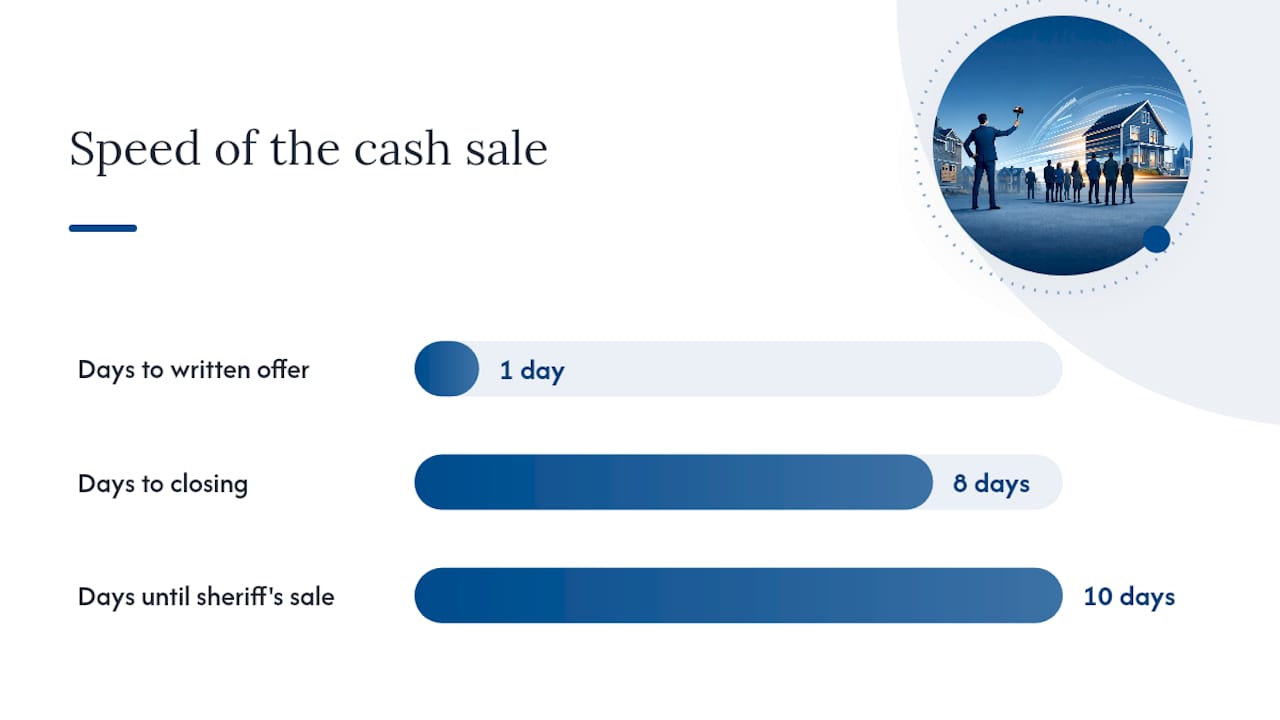
Consider a Metro Detroit homeowner with a sheriff’s sale scheduled in ten days. The property needed significant repairs, the homeowner had no funds for a traditional listing, and the servicer had not yet responded to an informal call. After contacting a local cash buyer, the homeowner received a written offer within 24 hours. That written purchase agreement was submitted to the servicer as evidence of a pending pre-sale resolution, which prompted the servicer to pause the sale while the transaction completed. The closing happened in eight days.
What the homeowner needed to provide: proof of ownership, the most recent mortgage statement, and access to the property for a walkthrough. The buyer handled the title search, coordinated with the title company, and covered standard closing costs. No repairs were made. No realtor commissions were paid.
The net proceeds were below the home’s full market value, as is typical with a fast cash sale. But they exceeded what an auction would have returned, because the lender’s credit bid at auction would have left nothing for the homeowner after the debt was satisfied. The homeowner also avoided a deficiency judgment and the eviction process entirely.
- Verify any cash buyer by requesting proof of funds in writing before signing anything.
- Insist on a clear purchase agreement that states the closing date, purchase price, and which costs the buyer covers.
- Confirm the buyer has closed similar transactions in Metro Detroit recently — local experience with title companies and county processes matters when speed is the priority.
Pro Tip: Ask the buyer for references from recent Metro Detroit closings and confirm their proof of funds is a current bank statement or letter from a financial institution, not a vague commitment letter. A legitimate buyer will provide both without hesitation.
What we’ve seen helping Detroit homeowners in foreclosure
The pattern we see most often at Sell Dave Your House is homeowners who waited too long to call anyone. By the time they reached out, the auction was days away and several options that were available weeks earlier had already closed. Loan modification takes time. Short sales take time. Even a fast cash sale needs a few days to close properly.
The single most important step you can take today is to call your servicer and ask for the loss-mitigation department in writing, then call a HUD-approved counselor or a local foreclosure attorney the same day. If you want to explore a cash sale, get a written offer in hand so you have something concrete to work with.
Professional help early — whether that is a HUD counselor, a foreclosure attorney, or a trusted local cash buyer — consistently produces better outcomes than waiting.
Facing a Metro Detroit auction? Here is how Sell Dave Your House can help
If your auction date is approaching and you need a fast, certain exit, Sell Dave Your House has spent over 16 years helping Metro Detroit homeowners sell as-is for cash before the sheriff’s sale. The process is direct: you receive a fair cash offer within 24 hours, and closing can happen in as little as seven days.

There are no repairs to make, no realtor commissions to pay, and no financing contingencies that could fall through at the last minute. Sell Dave Your House covers standard closing costs and provides a written purchase agreement you can present to your servicer as evidence of a pending pre-sale resolution. That written agreement has helped homeowners pause scheduled sales while the transaction completes.
Whether your property is in Warren, Redford, Hazel Park, or anywhere across Metro Detroit, the process is the same: one walkthrough, one written offer, one closing. To get your cash offer today, visit the Detroit cash home buyers page or go directly to get a fair cash offer and fill out the short form. Someone will be in touch within 24 hours.
Useful resources to check now
Getting the right help fast is what separates homeowners who stop an auction from those who don’t. Start with these:
- Credit impact research: Federal Reserve study on foreclosure and credit scores — the clearest evidence of how long the damage lasts.
- Deficiency judgment rules: Nolo’s deficiency judgment guide and LegalClarity’s defenses overview — check your state’s rules and know your defenses before the sale.
- Free housing counseling: HUD-approved housing counselors — free, available by phone, and counselors know Michigan-specific timelines.
- CFPB loss-mitigation guidance: The Consumer Financial Protection Bureau explains your rights under dual-tracking protections and what a complete application requires.
- How a cash sale stops foreclosure: Sell Dave Your House’s guide explains the mechanics of a pre-sale cash transaction and what to expect.
- Stop a sale fast: The stop foreclosure sale fast page covers step-by-step timelines for imminent sales.
- Get a cash offer now: Selldaveyourhouse — for homeowners who need an offer within 24 hours.
- Homeowner liability after sale: For questions about surviving liens and post-sale liability exposure, this homeowner liability coverage guide covers the basics.
This article is general information, not a substitute for advice from a qualified financial advisor. Consult a qualified financial professional about your own circumstances before acting on anything here.
Sources
- Foreclosures and the Credit Market: Evidence from a Large Panel of U.S. Households (Federal Reserve paper)
- Foreclosure Deficiency Judgments: Rules, Risks, and Defenses - LegalClarity
- Deficiency judgments: Will you still owe money after the foreclosure? | Nolo
- How Foreclosures Work: Timeline, Auction Process & Where Investors Buy (2026) | Foreclosure Data Hub
- What Is a Foreclosure Auction? What Happens and What Homeowners Must Know | Mortgage Options Network
FAQ
What happens to your credit score after a foreclosure auction?
Credit scores drop significantly before and during foreclosure and can remain 50–75 points below expected levels more than seven years after the event, according to Federal Reserve research. The foreclosure record stays on your credit report for seven years.
Can a lender still sue you after a foreclosure auction?
Yes, in many states. If the auction price is less than your loan balance, the lender may file for a deficiency judgment and use it to garnish wages or levy bank accounts. State law and foreclosure method determine whether this is permitted, so check Michigan’s rules with a foreclosure attorney.
What is the fastest way to stop a foreclosure auction?
A bankruptcy filing triggers an automatic stay that halts the sale immediately. A complete loss-mitigation application filed before the applicable deadline also triggers dual-tracking protections. A verified cash sale with a written purchase agreement can pause a sale while the transaction closes.
How can a cash sale help you avoid foreclosure auction risks?
A local cash buyer like Sell Dave Your House can provide a written offer within 24 hours and close in as little as seven days, giving you a concrete pre-sale resolution to present to your servicer before the auction date.
Does a short sale eliminate your deficiency risk automatically?
No. A short sale or deed in lieu does not eliminate deficiency risk unless the lender expressly waives it in writing. Always negotiate and document the waiver before signing the closing paperwork.