

How an As-Is Home Sale Works: A Clear 2026 Guide
TL;DR:
- An as-is home sale involves transferring a property in its current condition without requiring repairs. Sellers must disclose known defects and comply with federal and state disclosure laws, even when selling as-is. This process enables faster transactions but may lead to a lower sale price compared to renovated homes.
An as-is home sale is defined as the transfer of a property in its current physical condition, with no obligation on the seller to make repairs, upgrades, or improvements before closing. Understanding how as-is home sale works is critical because the term does not mean you can hide problems. You still carry legal disclosure duties, and buyers still hold the right to inspect. The as-is designation manages expectations, not transparency.
What are the legal obligations in an as-is home sale?
Selling as-is removes your repair obligation. It does not remove your duty to disclose. As-is primarily manages buyer and seller expectations. It does not avoid transparency or legal disclosure requirements.
Federal law sets a firm baseline. Sellers of homes built before 1978 must disclose known lead-based paint hazards, regardless of the as-is designation. The EPA enforces this rule with civil penalties up to $19,507 per violation in 2026. That number reflects how seriously regulators treat concealment, even when a seller believes the as-is clause protects them.
Beyond federal rules, each state requires its own seller disclosure forms. These forms ask about structural defects, water intrusion, roof condition, HVAC systems, and more. The specific categories vary by state, but the principle is consistent: you must disclose what you know.
The legal distinction that trips up most sellers is this: the as-is clause covers your repair obligation, not your knowledge. Courts hold sellers liable for intentional concealment even when an as-is clause is present. An as-is sale only shields you from unknown or hidden defects you genuinely were not aware of.
- Disclose all known material defects on state-required seller disclosure forms
- Include lead-based paint disclosures for homes built before 1978
- Do not rely on the as-is clause to avoid sharing information you already have
- Consult a real estate attorney if you are unsure what your state requires
Pro Tip: Complete your seller disclosure form before listing. Buyers and their agents review it early, and a thorough form signals good faith, which reduces the chance of post-closing legal disputes.
Disclosing known defects early with state-required forms protects sellers from future legal action. Comprehensive disclosure reduces the risk of post-closing fraud claims significantly.
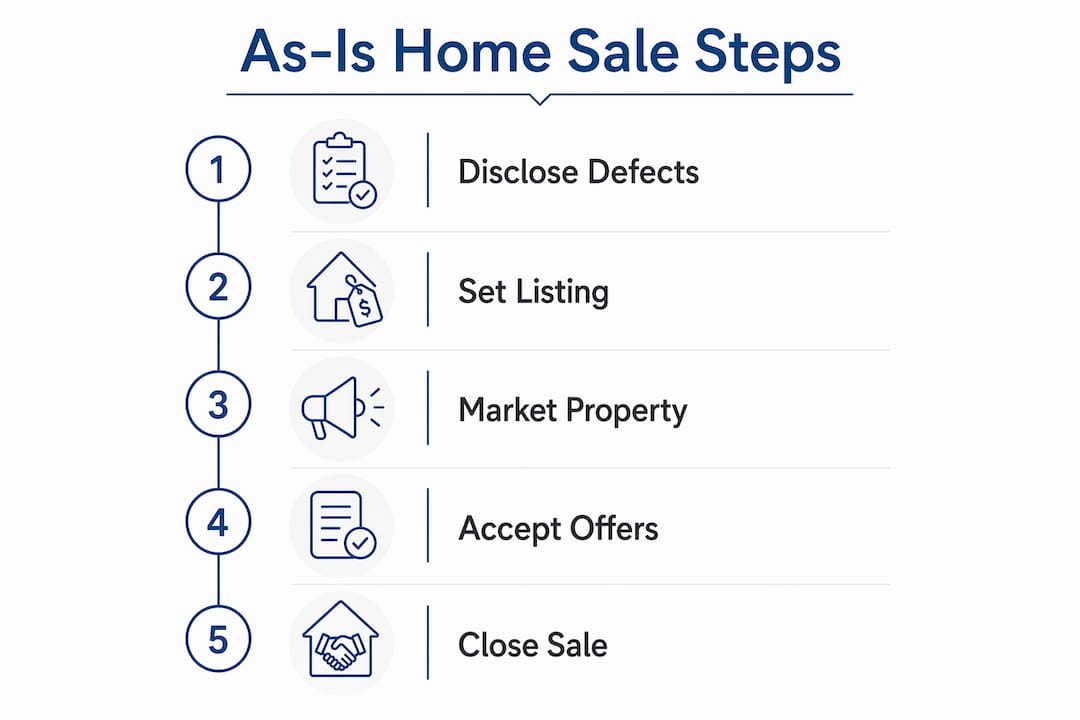
How does the as-is home selling process work?
The as-is home selling process follows a clear sequence. Knowing each step helps you avoid surprises and keep the transaction moving forward.
-
List with an as-is designation. Your listing agent includes “sold as-is” in the MLS remarks. This signals to buyers and their agents that no repairs or credits will be offered. Clear language upfront filters out buyers who expect move-in-ready condition.
-
Complete all required disclosures. Before or at the time of listing, fill out your state’s seller disclosure form. Attach the lead-based paint disclosure if the home was built before 1978. Buyers receive these documents before making an offer.
-
Accept an offer with inspection contingency language. Most buyers include an inspection contingency even in as-is transactions. Buyers can still back out of as-is sales if they include an inspection contingency in their offer. Waiving this contingency limits their exit options but is more common with cash buyers.
-
Buyer conducts the inspection. Inspection contingency periods in as-is sales typically range from 5–15 days. Florida defaults to 15 days; many states default to 7–10 days. During this window, the buyer hires a licensed inspector to evaluate the property.
-
Buyer decides based on inspection results. Despite selling as-is, buyers conduct inspections to verify property condition and then negotiate price or walk away based on results. As the seller, you are not obligated to repair anything. You can hold firm on price, offer a small credit, or let the buyer exit.
-
Proceed to closing. Once the inspection period ends without cancellation, the transaction moves to title search, underwriting (for financed buyers), and closing. Cash transactions skip underwriting entirely, which is why they close faster.
Pro Tip: State explicitly in your listing remarks and purchase contract that “seller will not perform repairs or offer credits.” Clear as-is contract language reduces renegotiation attempts during escrow by setting firm repair expectations before inspection.
What are the benefits and drawbacks of selling a home as-is?

The as-is route is not right for every seller. Understanding where it helps and where it costs you lets you make a clear-eyed decision.
Benefits of selling as-is
- No upfront repair costs. You avoid spending money on renovations that may not return full value at closing.
- Faster sale timeline. Skipping the repair phase shortens the time from decision to closing. Cash buyers in particular can close in as little as seven days.
- Less negotiation friction. When buyers know the terms upfront, there are fewer surprises during escrow.
- Attracts investor buyers. Investors and fixer-upper specialists actively seek as-is properties. They price in repair costs and move quickly.
- Ideal for specific situations. Inherited properties, distressed homes, and downsizing moves all benefit from the speed and simplicity of an as-is sale.
Drawbacks to consider
Selling a home as-is typically lowers the final sale price compared to fully renovated homes. The net outcome depends on what repairs would have cost versus how much they would have added to the sale price. That math is different for every property.
Buyer perception is the other challenge. Some buyers see “as-is” and assume the worst, even when the home is in reasonable condition. This narrows your buyer pool and can extend days on market if you price too high.
| Factor | As-is sale | Traditional sale |
|---|---|---|
| Repair costs | None required | Often $5,000–$50,000+ |
| Time to close | 7–30 days (cash) | 30–90 days |
| Buyer pool | Investors, cash buyers | Broader retail market |
| Sale price | Typically lower | Typically higher |
| Negotiation risk | Lower after listing | Higher during escrow |
The as-is approach works best when speed and certainty matter more than maximizing sale price. For homeowners facing foreclosure, financial hardship, or a time-sensitive move, the tradeoff is often worth it.
What practical tips help sellers succeed with an as-is sale?
Preparation separates a smooth as-is transaction from a deal that falls apart at inspection. These steps give you the best chance of closing on time and without legal exposure.
- Fill out your disclosure form completely. Do not leave fields blank. A thorough disclosure form is your primary legal protection. Comprehensive seller disclosure forms reduce the risk of post-closing fraud claims.
- State your terms clearly in writing. Include “seller will not perform repairs or offer credits” in both the MLS remarks and the purchase contract. Explicit seller remarks help set expectations and prevent wasted showings from buyers who expect concessions.
- Price realistically from the start. Research comparable sales of distressed or unrenovated homes in your area. Overpricing an as-is home leads to price reductions and longer market time, both of which signal weakness to buyers.
- Target the right buyers. Using terms like “investor special” in your marketing attracts buyers who are comfortable with properties needing work. These buyers move faster and negotiate less aggressively on repair credits.
- Consider a direct cash offer. Working with a cash buyer eliminates the financing contingency, speeds up closing, and removes the risk of a deal falling through due to appraisal issues. For sellers who want certainty, this is the most reliable path.
Pro Tip: Get a pre-listing inspection on your own. You are not required to share the report, but knowing what an inspector will find lets you price accurately and disclose proactively. Surprises during the buyer’s inspection period are the leading cause of deal cancellations in as-is sales.
For homeowners who have inherited a property, the steps to sell an inherited home as-is follow the same framework but may involve additional probate steps depending on your state. Understanding the timeline early prevents delays at closing.
Investors who purchase as-is properties follow specific acquisition criteria. Reviewing property acquisition strategies from the buyer’s perspective helps you understand what they look for and how they price offers, which makes your negotiations more productive.
Key Takeaways
An as-is home sale removes your repair obligation but never removes your duty to disclose known defects, making full transparency the foundation of a legally sound transaction.
| Point | Details |
|---|---|
| Disclosure is mandatory | Federal and state law require you to disclose known defects even in as-is sales. |
| Buyers keep inspection rights | Inspection contingencies of 5–15 days give buyers the right to exit based on findings. |
| As-is lowers sale price | Expect a lower offer than a renovated home, but you save on repair costs and time. |
| Clear contract language matters | Stating no repairs or credits in writing reduces renegotiation attempts during escrow. |
| Cash buyers close fastest | Targeting investors and cash buyers shortens the timeline to as little as seven days. |
What I’ve learned from years of as-is home sales
The biggest misconception I see is that sellers treat “as-is” as a shield rather than a starting point. They assume the clause protects them from everything. It does not. What it actually does is set the terms of the negotiation before it starts. That is a powerful tool when used correctly.
The sellers who do best in as-is transactions are the ones who disclose everything upfront, price honestly, and target the right buyers from day one. They do not waste time on showings with retail buyers who will walk after inspection. They go straight to investors, cash buyers, and people who understand what they are buying.
Pricing is where most sellers leave money on the table. They price as if the home were renovated, then drop the price after inspection. That sequence destroys buyer confidence. Price it right from the start, and you attract serious buyers who close.
The other thing I tell every seller: get your disclosure form done before you list. Not after you accept an offer. Before. It signals honesty, it protects you legally, and it speeds up the transaction because buyers already know what they are getting into.
— Real Estate Team
Sell Dave Your House makes the as-is process straightforward
Selling your home as-is does not have to mean months of uncertainty or lowball offers from buyers who disappear after inspection.

Sell Dave Your House has over 16 years of experience buying homes in Detroit and surrounding communities exactly as they stand. No repairs, no agent commissions, and no hidden fees. You receive a fair, all-cash offer within 24 hours and can close in as little as seven days. Whether you are facing financial hardship, managing an inherited property, or simply ready to move on without the hassle of traditional listings, Sell Dave Your House gives you a clear path forward. Homeowners in Harper Woods, Hazel Park, and across Metro Detroit can request a fast cash offer and get a straightforward answer with no obligation.
FAQ
What does as-is mean in a real estate sale?
An as-is sale means the seller offers the property in its current condition and will not make repairs or provide credits before closing. The buyer accepts the property’s condition but retains the right to inspect and exit if the contract includes an inspection contingency.
Do I still have to disclose defects in an as-is sale?
Yes. Federal law requires disclosure of lead-based paint hazards in homes built before 1978, and state law requires disclosure of known material defects. An as-is clause does not override these obligations.
Can a buyer back out of an as-is sale after inspection?
Yes. Buyers can cancel during the inspection contingency period, which typically runs 5–15 days depending on the state and contract terms. Waiving the contingency removes this exit option.
How long does an as-is home sale take to close?
Cash transactions on as-is homes can close in as little as seven days. Financed purchases typically take 30–45 days due to underwriting and appraisal requirements.
Is selling as-is a good idea for inherited or distressed properties?
Selling as-is is often the most practical choice for inherited homes, distressed properties, and situations where repair costs would exceed the value they add. Speed and certainty outweigh the lower sale price in most of these cases.