

How Fast Closings Benefit Downsizers: 2026 Guide
TL;DR:
- Fast home sales close within 7 to 14 days, offering seniors control and reduced carrying costs.
- The net financial difference between cash and traditional sales is usually only $5,000 to $15,000 after expenses.
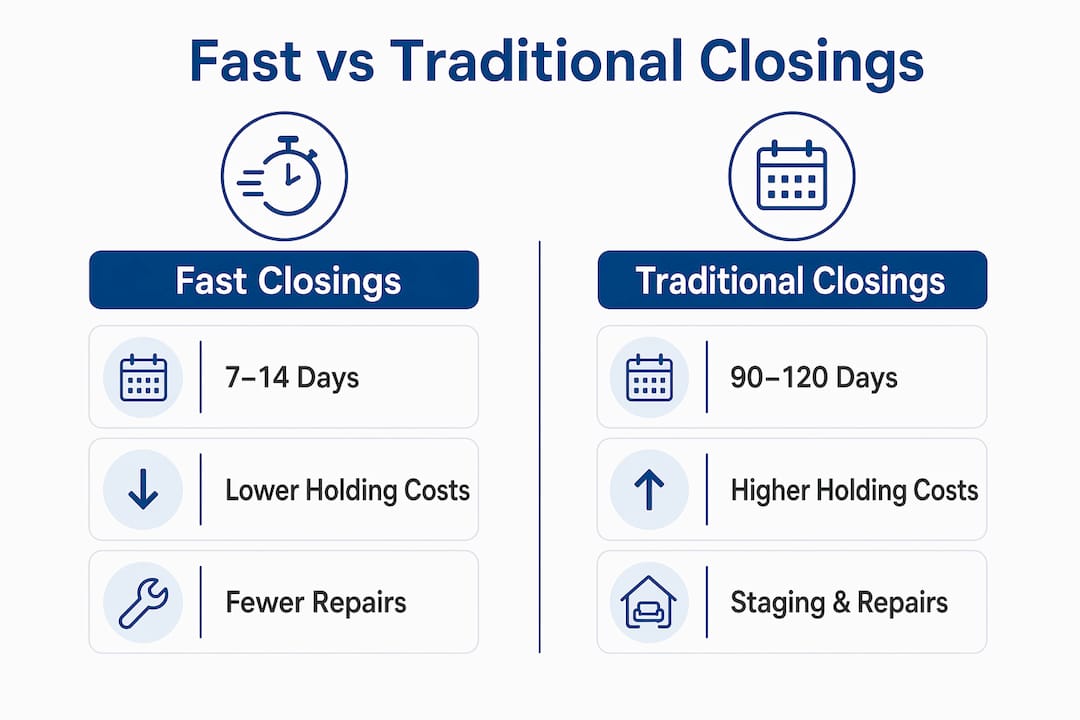
A fast closing is defined as a home sale that completes in 7–14 days, compared to the 90–120 days a traditional sale typically requires. For homeowners aged 50 and older, understanding how fast closings benefit downsizers goes beyond speed. It means fewer months of carrying costs, less physical disruption, and far more control over when and how you move. The financial gap between a cash sale and a traditional sale is often much smaller than you expect, and the certainty a quick sale provides can be worth every dollar of that difference.
What financial advantages do fast closings provide to downsizers?
The biggest financial surprise for most downsizers is that a fast cash sale rarely costs as much as they fear. The net financial difference between a cash sale and a traditional sale is often only $5,000–$15,000 after all costs are counted. That is far less than the $50,000 gap many homeowners assume.
The reason the gap shrinks is holding costs. A traditional sale that takes around 113 days generates what financial planners call “transition burn.” This includes property taxes, utilities, insurance, and maintenance on a home you are no longer living in. Those hidden transition costs can total $18,000–$28,000 over a typical traditional selling period. That figure alone often exceeds the price difference between a cash offer and a market-rate offer.
There are also the costs you avoid entirely with a fast sale. Traditional sales typically require staging, repairs, and agent commissions. Professionally staged homes sell 73% faster and for 1–5% more, but cash buyers waive staging and repair requirements completely. That saves you both time and out-of-pocket money before you ever see a dollar from the sale.
Pro Tip: When comparing a cash offer to a traditional listing price, calculate your total transition costs, not just the sale price. Add up estimated holding costs, staging fees, agent commissions, and repair expenses before deciding which route puts more money in your pocket.
| Cost category | Traditional sale | Fast cash sale |
|---|---|---|
| Holding costs (taxes, utilities) | $18,000–$28,000 | Minimal to none |
| Staging and repairs | $3,000–$10,000+ | $0 (waived by buyer) |
| Agent commissions | 5–6% of sale price | $0 |
| Net price difference | Higher list price | $5,000–$15,000 less |
How does the timeline of fast closings compare to traditional home sales for seniors?
Speed is the defining advantage of a cash sale, and the difference is dramatic. Fast cash closings for downsizers typically close in 7–14 days, while traditional sales in many US markets take 90–120 days. That is a gap of roughly three months of uncertainty, carrying costs, and waiting.
Traditional sales also carry a hidden risk that the timeline numbers do not fully capture. Nearly 19% of traditional deals fall through before closing due to financing failures, appraisal disputes, or inspection contingencies. When a deal collapses at the 90-day mark, you restart the entire process. That kind of delay is especially disruptive when you have already committed to a move-in date at your next home.
A fast cash sale removes those variables entirely. There is no mortgage underwriting, no appraisal, and no inspection contingency to derail the deal. Short closings signal a serious, organized transaction, which reduces the risk of last-minute surprises for both parties.
Here is how the two timelines compare at each stage:
Traditional sale timeline:
- Week 1–2: Prepare, stage, and list the home
- Week 3–6: Showings, open houses, and offer negotiations
- Week 7–10: Buyer financing, appraisal, and inspection
- Week 11–16: Underwriting, contingency resolution, and closing
Fast cash sale timeline:
- Day 1: Submit property details and receive a cash offer within 24 hours
- Day 2–5: Review offer, negotiate closing date, and sign the contract
- Day 6–14: Title search and closing paperwork completed
- Day 7–14: Closing day, funds transferred, and transaction complete
The practical implication is clear. A fast sale lets you coordinate your move with confidence. You know the exact closing date from day one, which makes scheduling movers, securing your next home, and notifying utilities straightforward.
What logistical benefits do fast closings offer senior homeowners downsizing?
A fast cash sale removes nearly every physical and logistical burden that makes traditional home sales exhausting. Cash buyers purchase homes as-is, which means you skip repairs, deep cleaning, and the weeks of preparation that a traditional listing demands. For homeowners who have lived in a property for decades, that relief is significant.

Showings are one of the most disruptive parts of a traditional sale. You need to keep the home spotless, leave on short notice, and repeat that process for weeks. A cash sale eliminates showings entirely. You meet with one buyer, agree on terms, and move forward. That reduction in disruption matters when you are managing a move, sorting belongings, and planning your next chapter.
One of the most practical tools available in a fast sale is the rent-back agreement. Rent-back agreements allow you to stay in the home 30–60 days after closing to ease moving logistics without carrying double housing expenses. This gives you the cash from the sale in hand while you finish sorting, packing, and coordinating your move at a reasonable pace.
Pro Tip: When negotiating a fast cash sale, ask about a rent-back option before signing. Even 30 days of post-closing occupancy can remove the pressure of a rushed move and give you time to sort belongings without paying for temporary storage or a second residence.
The logistical advantages of a fast cash sale include:
- No repairs or renovations required before listing
- No staging costs or professional photography sessions
- No repeated showings or open houses
- No mortgage contingency or appraisal delays
- Flexible closing date set at your convenience
- Rent-back option available to ease move timing
- Single point of contact throughout the transaction
For a deeper look at how skipping repairs and contingencies works in practice, the guide on as-is sale benefits explains the process clearly.
How can downsizers make fast closings work best for their situation?
The single most important thing you can do is start early. Sorting belongings and decluttering typically takes 3–6 months for senior homeowners, and rushing that process increases emotional distress. Starting the preparation phase well before you list gives you control over the pace and reduces the pressure of a tight moving deadline.
Waiting until your 80s to downsize makes the physical and emotional process significantly harder. The best time to plan a downsizing transition is before an urgent need forces your hand. Health changes, mobility limitations, or a family crisis can compress your timeline in ways that eliminate your options. Acting proactively keeps you in control.
Here is a practical sequence for making a fast closing work in your favor:
- Start sorting 3–6 months before you plan to sell. Divide belongings into keep, donate, sell, and discard categories. Work room by room to avoid feeling overwhelmed.
- Consult a professional familiar with senior transitions. Real estate professionals who specialize in downsizing understand the emotional and logistical complexity of the process. They can help you evaluate your financial position and timeline realistically.
- Request cash offers early to understand your baseline. You do not have to accept an offer to learn what your home is worth in a fast sale. Getting an offer gives you a concrete number to compare against your estimated net proceeds from a traditional sale.
- Negotiate closing date flexibility. A good cash buyer will work around your schedule. Ask for a closing date that aligns with your move-in date at your next home, and confirm whether a rent-back option is available.
- Evaluate your full financial picture before deciding. Consider your health, lifestyle goals, and housing costs at your next home alongside the sale price. The role of home sale in your retirement plan matters as much as the number on the offer sheet.
For homeowners who want a side-by-side breakdown of costs and proceeds, the cash vs. traditional sale guide provides a detailed comparison. You can also review cash home buyer options to understand what to expect from the process before you commit.
Key Takeaways
Fast closings benefit downsizers most when holding costs, logistical complexity, and timeline certainty matter more than squeezing the last dollar from a traditional sale.
| Point | Details |
|---|---|
| Net price gap is smaller than expected | The real difference between cash and traditional sales is often only $5,000–$15,000 after all costs. |
| Holding costs erode traditional sale gains | Transition burn of $18,000–$28,000 over a 113-day sale often exceeds the cash offer discount. |
| Fast closings take 7–14 days | Cash sales close in 7–14 days versus 90–120 days for traditional sales, removing months of uncertainty. |
| Rent-back agreements ease the move | Negotiating 30–60 days of post-closing occupancy lets you move at your own pace without dual housing costs. |
| Start sorting 3–6 months early | Beginning decluttering well before listing reduces stress and keeps your timeline firmly in your control. |
What I’ve learned about speed and certainty in downsizing
After working with homeowners through dozens of downsizing transitions, the pattern I see most often surprises people. The homeowners who wait for the highest possible price frequently end up with less money in hand than those who accepted a fast cash offer. The math is straightforward once you account for carrying costs, repairs, and the emotional toll of a prolonged sale. But the math is not the whole story.
What I have found is that control over timing matters more to most downsizers than the extra few thousand dollars a traditional sale might generate. When you know your closing date on day one, you can plan your next chapter with confidence. You can book movers, finalize your next home, and tell your family exactly when the transition happens. That certainty has real value that does not show up on a spreadsheet.
The homeowners who struggle most are those who wait too long. By the time a health change or family situation forces the decision, their options have narrowed. A proactive downsizer who starts the process early, sorts belongings over several months, and requests a cash offer before urgency sets in has every advantage. Speed in the sale does not mean rushing the decision. It means making the decision on your terms, not someone else’s.
— Real Estate Team
Sell Dave Your House: fast closings for Detroit downsizers
Sell Dave Your House specializes in fast, fair cash offers for homeowners in Detroit who are ready to downsize without the complications of a traditional sale.

With over 16 years of experience, Sell Dave Your House delivers a cash offer within 24 hours and can close in as little as seven days. You sell as-is, with no repairs, no agent commissions, and no showings. Closing dates are flexible, and rent-back options are available to give you time to move at your own pace. If you are ready to take the next step, request a cash offer with no obligation and see exactly what a fast closing looks like for your situation. You can also learn more about the reasons to sell fast and why Detroit homeowners choose this path every day.
FAQ
How fast can a cash home sale actually close?
Fast cash closings typically complete in 7–14 days, compared to 90–120 days for a traditional sale. Sell Dave Your House can deliver a cash offer within 24 hours and close in as little as seven days.
Will I lose a lot of money selling my home for cash?
The net difference between a cash sale and a traditional sale is typically only $5,000–$15,000 after accounting for holding costs, repairs, staging, and commissions. Transition burn alone on a traditional sale can reach $18,000–$28,000, which often offsets the lower cash offer price.
What is a rent-back agreement and how does it help downsizers?
A rent-back agreement lets you stay in your home for 30–60 days after closing, giving you time to sort belongings and coordinate your move without paying for temporary housing. It is a negotiable term in most fast cash sales.
When is the right time to start the downsizing process?
Experts recommend starting the transition proactively, well before an urgent need arises. Sorting and decluttering alone typically takes 3–6 months, and waiting until your 80s makes the process physically and emotionally harder.
Do cash buyers require repairs or inspections before closing?
Cash buyers purchase homes as-is and typically waive repair requirements and inspection contingencies. This removes one of the main reasons traditional deals fall through and eliminates out-of-pocket costs before the sale.