
How to Sell a Condemned House Fast and As-Is
Yes, you can sell a condemned house. Condemnation does not transfer your title, so you retain the legal right to sell the property as-is, though you must disclose the condemnation to any buyer. According to PropertyChecker, most sales of condemned homes go to cash investors because traditional mortgage financing is rarely available for properties with active code violations or uninhabitability orders.
Here are three things to do right now:
- Secure your paperwork. Pull the official condemnation notice, any code enforcement inspection reports, and all citation records from your local building department. These documents are non-negotiable for any buyer’s due diligence.
- Check for municipal liens. Contact your county clerk’s office or run a title search to find out whether the city has recorded demolition, abatement, or code-violation liens against the property. These liens come out of your proceeds at closing and directly affect your net.
- Decide on your selling path. Cash buyers close fastest, sometimes in as little as 7 days. If you have time and equity, a repair-and-list path may net more, but it requires permits, contractor work, and a re-inspection. Know which situation you are in before you start making calls.
Key Takeaways
You can sell a condemned house legally in most U.S. states, but disclosure is mandatory, financing buyers are blocked, and your net proceeds depend heavily on recorded municipal liens and demolition costs.
| Point | Details |
|---|---|
| Legal right to sell | Condemnation does not transfer your title; you can sell as-is, but you must disclose the condemnation to every buyer. |
| Buyer pool is cash-only | Active condemnation orders block conventional mortgage financing, so expect investors and cash buyers as your realistic market. |
| Pricing formula | Offers are calculated as ARV minus rehab or demolition cost minus investor margin; discounts of 40%–70% versus habitable comparables are common. |
| Liens reduce your net | Municipal demolition liens of $6,000–$25,000 (or more) are paid from proceeds at closing and must be factored into your minimum acceptable price. |
| Sell Dave Your House | Buys condemned Metro Detroit homes for cash, with offers within 24 hours and closing in as little as 7 days, covering standard closing costs. |
Table of Contents
- What does it mean when a house is condemned?
- Can you legally sell a condemned house?
- Who will buy a condemned house, and what are your options?
- How much is a condemned house worth?
- How to sell a condemned house: a step-by-step checklist
- What happens to your mortgage and liens when you sell?
- Should you appeal, repair, or accept demolition?
- How Sell Dave Your House handles condemned properties in Metro Detroit
- An honest perspective on selling condemned properties
- Sell Dave Your House: a fast, transparent option for condemned homes
- Sources
- FAQ
What does it mean when a house is condemned?
“Condemned” is a term that covers two very different legal situations, and knowing which one applies to you shapes every decision that follows.
The first, and far more common, meaning is a building condemnation: a local government or code enforcement authority declares the structure unsafe or uninhabitable. Rocket Mortgage explains that this type of condemnation can be triggered by structural failure, severe fire or water damage, mold infestations, electrical or gas hazards, or accumulated code violations that make the property dangerous to occupy. The order restricts occupancy and typically requires the owner to repair the property to code or demolish it within a set deadline. Critically, it does not take your title away.
The second meaning is eminent domain: a government entity acquires your property for a public purpose, paying you “just compensation.” This is a fundamentally different process with its own legal protections, including your right to challenge the valuation and hire your own appraiser. If your situation involves eminent domain, the Congressional Research Service’s report on the subject is a reliable starting point for understanding your due-process rights.
Most homeowners searching for how to sell a condemned house are dealing with the first type. The rest of this article focuses there.
Can you legally sell a condemned house?
The short answer is yes, in most cases. Because condemnation does not strip you of title, you retain the right to sell. Redfin confirms that full transparency and documentation are critical, though, because concealing a condemnation notice exposes you to fraud claims and potential rescission of the sale.
Disclosure is mandatory
Most states require sellers to complete a property condition disclosure form that covers known code violations, government orders, and habitability issues. Condemnation notices fall squarely in that category. LegalClarity notes that sellers who hide violations or liens face legal exposure well beyond a failed deal. Even in states where condemnation notices are part of the public record and buyers are expected to perform their own due diligence, sellers still carry strict disclosure obligations to avoid liability.
Financing is almost always blocked
Lenders underwrite against the property as collateral. An active condemnation order makes the property unacceptable collateral for a conventional mortgage, FHA loan, or VA loan. Expect your buyer pool to be almost entirely cash buyers or investors using hard-money financing. This is not a deal-breaker; it simply defines who will make you an offer.
State and local rules vary
Disclosure forms, appeal deadlines, and lien-recording procedures differ by state and municipality. Check your local building department’s website and your county clerk’s public records portal for the specific rules in your area. A real estate attorney familiar with your county can review your condemnation notice and tell you exactly what your obligations are before you list.
Documents to pull before you do anything else:
- Official condemnation or unsafe-structure notice
- Code enforcement inspection reports and citation records
- Any permits pulled (or denied) on the property
- Lien search results from the county recorder’s office
- Mortgage payoff statement from your servicer
- Seller disclosure forms required by your state
Who will buy a condemned house, and what are your options?
The realistic buyer pool for a condemned property is narrower than for a standard home, but it is not empty. Understanding who these buyers are helps you target your outreach and set realistic expectations.
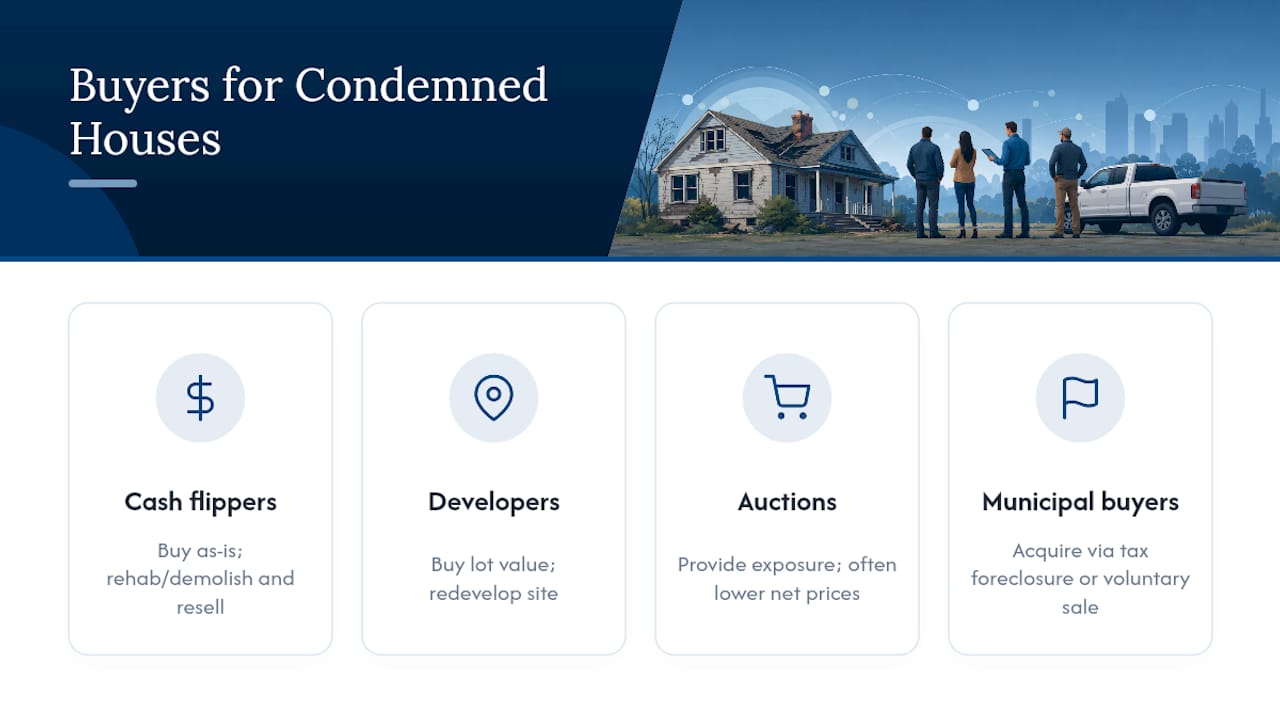
Local cash investors and flippers are the most active buyers. They purchase distressed properties, factor in rehab or demolition costs, and resell or redevelop. They move quickly and are comfortable with as-is purchases.
Developers and land buyers are interested when the lot has value independent of the structure. In dense urban markets like Detroit, a condemned house on a well-located lot can attract developer interest even if the building is a total loss.
Auction houses and tax-auction platforms offer a path to market exposure, though auction sales typically yield lower prices and come with buyer premiums that reduce your net.
Municipalities and land banks sometimes acquire condemned properties through tax foreclosure or voluntary sale programs. Detroit’s Detroit Land Bank Authority is one example of a public entity that acquires and redevelops distressed properties.
Selling options compared
Municipal liens and demolition-cost liens change the math on every path. A buyer taking on a property with a $15,000 recorded demolition lien will price that lien into their offer, reducing what you receive at closing.
How much is a condemned house worth?
Condemned houses are worth substantially less than comparable habitable homes, with discounts commonly cited in the 40%–70% range versus habitable comparables. The exact figure depends on demolition cost, lot quality, location, and whether hazardous materials like asbestos or lead paint are present.
The valuation formula investors use is straightforward:
Offer = After-Repair Value (ARV) minus Rehab or Demolition Cost minus Investor Profit Margin minus Holding Costs
Here is a simplified example for a Detroit-area property:
- ARV of a comparable renovated home on the same street: $120,000
- Estimated full rehab cost: $55,000
- Investor profit margin (typically 10%–20% of ARV): $18,000
- Holding costs (taxes, insurance, utilities during rehab): $5,000
- Estimated cash offer: roughly $42,000
If demolition is the more realistic path, the math shifts. LegalClarity reports that municipal demolition costs for a standard single-family home commonly run in the low to mid tens of thousands of dollars, and can be substantially higher when hazardous materials are involved. Those costs, if already recorded as liens, reduce your net proceeds dollar for dollar.
Pro Tip: Get at least two contractor estimates and one demolition quote before you accept any offer. Knowing the actual rehab and demolition numbers lets you evaluate whether an investor’s offer is fair or whether they are padding their margin at your expense.
The lot’s standalone value matters too. In some Detroit neighborhoods, a cleared lot sells to a developer or neighbor for $10,000–$30,000. In others, land value is minimal. Check recent vacant-lot sales in your zip code through your county assessor’s records to anchor your expectations.
How to sell a condemned house: a step-by-step checklist
This process works whether you are selling to a cash buyer, listing with a specialist agent, or going to auction. Follow it in order.
- Secure all official documents. Obtain the condemnation notice, all code enforcement reports, and any demolition orders from your local building department. Request copies in writing so you have a paper trail.
- Run a title search. Order a title search through a local title company or real estate attorney. This surfaces all recorded liens, including municipal demolition liens, unpaid property taxes, and any judgment liens. You cannot negotiate a clean sale without knowing what is attached to the title.
- Contact your mortgage servicer. If you have an outstanding mortgage, call your servicer before you list. National Mortgage News explains that mortgage obligations continue after condemnation, but servicers and agencies like Fannie Mae and Freddie Mac may offer forbearance or loss-mitigation options. Getting ahead of this conversation protects your credit and gives you more flexibility at closing.
- Get repair and demolition estimates. Contact at least two licensed contractors for rehab estimates and one demolition company for a teardown quote. These numbers anchor your pricing and help you evaluate offers.
- Choose your selling path. Based on your timeline, equity position, and lien load, decide whether a cash sale, specialist listing, or auction fits best. If you need to close in under 30 days, a cash buyer is your most realistic option.
- Prepare your disclosure package. Compile the condemnation notice, code reports, lien payoff statements, and your state’s required seller disclosure form. Every buyer should receive this package before making an offer.
- Market to cash buyers. For a condemned property, direct outreach to local investors, posting on investor-focused platforms, and contacting local cash-buying companies will reach your most likely buyers faster than a standard MLS listing.
- Negotiate with full information. Know your lien totals, your mortgage payoff, and your minimum acceptable net before you enter any negotiation. Buyers will factor every known cost into their offer.
- Close with a title company. At closing, recorded liens are typically paid from proceeds before you receive your net. Confirm with your title company that all municipal lien payoffs are included in the closing statement. Ask for a buyer acknowledgment clause in the purchase agreement confirming the buyer accepts the property in its condemned, as-is condition.
Documents to have ready at closing:
- Condemnation notice and all code enforcement records
- Lien payoff statements from the municipality
- Mortgage payoff statement
- Completed seller disclosure form
- Any permits or contractor records related to the property
For Metro Detroit sellers, the selling process for a house in disrepair in Detroit follows many of the same steps and local requirements.
What happens to your mortgage and liens when you sell?
Your mortgage does not disappear because the house is condemned. The lender still holds a security interest in the property, and the loan balance is still due. Calling your servicer early is one of the most important steps you can take. Fannie Mae and Freddie Mac both maintain forbearance and loss-mitigation policies that can apply when a property is condemned or destroyed, and your servicer can walk you through what options are available for your specific loan type.
Municipal liens deserve equal attention. When a city performs demolition or abatement work on a condemned property and the owner does not pay, the municipality records the cost as a lien against the title. These liens often carry high priority, meaning they are paid before you see any proceeds at closing.
Practical steps for managing mortgage and lien issues:
- Call your mortgage servicer as soon as you decide to sell. Ask specifically about forbearance, loan modification, and short-sale options if your payoff exceeds your expected sale price.
- Request a formal lien payoff statement from your municipality’s code enforcement or finance department. This is the number your title company needs to clear the title.
- Ask your title company whether any liens can be negotiated down. Municipalities sometimes accept reduced payoffs, particularly when the alternative is a prolonged tax-foreclosure process.
- If demolition has not yet occurred, confirm in writing with the city whether you can sell before demolition is scheduled. Some municipalities will pause demolition orders during an active sale process.
For sellers in the broader Metro Detroit area, resources like the Wyandotte and Redford city-specific pages cover local lien and code enforcement processes in more detail.
Should you appeal, repair, or accept demolition?
Not every condemned property needs to be sold immediately. Three other paths exist, and each makes sense under specific conditions.
Appealing the condemnation
An appeal is worth pursuing when there are procedural errors in the condemnation order, when you believe the scope of violations is overstated, or when an independent inspection shows the property can be made safe at a cost that leaves you with meaningful equity. Community Teamwork’s guidance for condemned homeowners recommends obtaining an independent inspection and a contractor estimate showing the property can be brought to code. These documents are the core of any appeal to your local code enforcement office. Appeal deadlines are typically short, often 10–30 days from the date of the notice, so act quickly.
Repairing to code
If the repair cost is manageable relative to the property’s post-repair value, pulling permits and completing the work can restore the home to a marketable condition. You will need licensed contractors, a permit from your building department, and a final inspection to receive a certificate of occupancy. The timeline for this path typically runs 3–12 months depending on the scope of work and permit processing times in your municipality.

Accepting demolition and selling the lot
When repair costs exceed the property’s after-repair value, or when zoning limits future residential use, selling the cleared lot is often the most economically rational choice. Developer interest in vacant lots varies sharply by neighborhood, so check recent comparable lot sales before assuming the land has value. If the city has already scheduled demolition, you may still be able to sell the property before the work begins, but time is short.
A simple decision framework:
- Repair cost is less than 50% of ARV and you have the capital: consider repairing and re-listing.
- Repair cost is 50%–80% of ARV: a cash sale as-is is likely your best net outcome.
- Repair cost exceeds ARV, or the structure is a total loss: sell the lot or negotiate with the municipality.
How Sell Dave Your House handles condemned properties in Metro Detroit
For homeowners who need to move quickly, Sell Dave Your House offers a direct cash-buying process built specifically for properties in distressed or condemned condition. The process works like this: you reach out, the team reviews the property, and you receive a fair all-cash offer within 24 hours. There are no repairs required, no cleaning, and no realtor commissions. Sell Dave Your House covers standard closing costs, and the transaction can close in as little as 7 days.
To illustrate how the numbers might work: on a Metro Detroit property with an ARV of $100,000, estimated rehab costs of $45,000, and a recorded municipal lien of $8,000, a realistic cash offer might land around $30,000–$40,000. After the lien payoff at closing and with no realtor commission deducted, the seller’s net is often comparable to or better than what a traditional listing would yield after agent fees, carrying costs, and the uncertainty of a buyer financing falling through.
With over 16 years of experience buying homes across Metro Detroit, Sell Dave Your House has worked through condemned properties, inherited homes, and situations involving significant municipal liens. The team is transparent about how offers are calculated and what the closing statement will look like before you sign anything. Learn more about how the cash-sale process works and what to expect at each step.
Red flags to watch for when evaluating any cash buyer:
- Reluctance to provide proof of funds before you sign a purchase agreement.
- Contracts with long inspection periods that allow the buyer to renegotiate or walk away after tying up your property.
- Offers with no written explanation of how the price was calculated.
- Pressure to sign before you have reviewed the lien payoff statements.
A credible cash buyer will show you proof of funds, explain their offer math, and give you time to review the contract with an attorney if you choose.
An honest perspective on selling condemned properties
When a house is condemned, the instinct is often to wait and hope the situation resolves itself. It rarely does. Code enforcement deadlines pass, demolition liens accumulate, and the property’s value erodes while the carrying costs continue. The homeowners who come out of this situation in the best position are the ones who act early, gather their documents, and make a clear-eyed decision about which path actually fits their financial reality.
The conventional wisdom in real estate is that you should always try to maximize your sale price. For a condemned property, that advice can be expensive. Spending six months pursuing permits and contractor bids, only to discover the repair cost exceeds the ARV, costs you time, money, and options. A fast cash sale at a realistic price is often the better financial outcome, not a compromise.
Disclosure is non-negotiable. Concealing a condemnation notice to attract a higher offer or a financed buyer is not a gray area; it is fraud. Any buyer who later discovers an undisclosed condemnation has grounds to rescind the sale and pursue damages. The legal and financial exposure from concealment far outweighs any short-term gain.
For most homeowners in this situation, the clearest path forward is: get the documents, know your liens, get a realistic offer from a credible cash buyer, and close. That sequence is not giving up. It is making the best decision with the information you have.
Sell Dave Your House: a fast, transparent option for condemned homes
Facing a condemned property in Metro Detroit is stressful enough without the added complexity of a months-long listing process, uncertain financing, and realtor commissions eating into your proceeds. Sell Dave Your House buys condemned and severely distressed homes directly for cash, with no repairs, no cleaning, and no fees charged to you.

The process is designed for exactly this situation: you get a fair all-cash offer within 24 hours, a clear explanation of how the offer was calculated, and the ability to close in as little as 7 days. Sell Dave Your House covers standard closing costs, so the offer you receive is close to the net you walk away with. With 16 years of experience in Metro Detroit, the team has handled condemned properties, inherited homes, and complex lien situations across the region, from Detroit to Harper Woods and beyond.
If you are ready to move forward, contact Sell Dave Your House today to request your no-obligation cash offer and get a clear picture of what your property is worth in its current condition.
Sources
Knowing where to look for authoritative information saves time and protects you from acting on outdated guidance.
- Can You Buy or Sell a Condemned Property? — PropertyChecker
- What is condemnation in real estate? | Rocket Mortgage
- Can You Sell a House With Code Violations? Options and Risks - LegalClarity
This article provides general information about selling condemned properties and is not a substitute for legal, financial, or tax advice. Consult a qualified attorney, tax professional, or financial advisor for guidance specific to your situation and jurisdiction.
FAQ
Can you sell a house that is condemned?
Yes. Condemnation does not remove your ownership rights, so you can sell a condemned house as-is. Disclosure of the condemnation to any buyer is mandatory in most states, and your buyer pool will typically be limited to cash investors.
How much is a condemned house worth?
Municipal liens recorded against the property reduce your net proceeds further.
What can I do with a condemned house?
Your main options are selling as-is to a cash buyer, appealing the condemnation with an independent inspection and contractor estimate, repairing the property to code and re-listing, or accepting demolition and selling the cleared lot.
Can you legally live in a condemned house?
No. A condemnation order restricts occupancy, meaning it is illegal to live in the property until the violations are corrected and the order is lifted by the local authority. Continuing to occupy a condemned home can result in fines or forced removal.
Does a condemned house affect your mortgage?
Yes. Your mortgage obligation continues regardless of the property’s condition. Contact your servicer early, as agencies like Fannie Mae and Freddie Mac offer forbearance and loss-mitigation options that may apply to your situation.