

The Role of Home Sale in Retirement Planning
TL;DR:
- Selling your home in retirement can provide essential funds, but planning for costs, taxes, and lifestyle changes is crucial. Proper timing, thorough financial modeling, and working with professionals help maximize benefits and avoid surprises. Your home sale impacts both your financial security and the quality of your retirement lifestyle.
Selling your primary residence is defined as one of the most consequential financial decisions you will make in retirement. The role of home sale in retirement goes far beyond simply cashing out. For most retirees, home equity represents roughly 70% of their total net worth. That single number explains why the decision to sell, when to sell, and how to reinvest the proceeds deserves the same careful attention you give your 401(k) or pension. The IRS also offers meaningful tax relief: single filers can exclude up to $250,000 in capital gains, and married couples filing jointly can exclude up to $500,000, provided they meet the ownership and use tests.
How does selling your home affect your retirement finances?
The financial impact of home sale on retirement income is direct and significant. When you sell and reinvest the net proceeds, those funds can generate reliable income for years. Investing $145,000 at a 4% withdrawal rate produces roughly $5,800 annually. That figure compounds meaningfully if your home sells for $400,000 or more.

Understanding the IRS capital gains exclusion
The IRS capital gains exclusion is the most valuable tax benefit available to homeowners selling a primary residence. To qualify, you must have owned and lived in the home for at least two of the last five years before the sale. This is known as the ownership and use test. Meeting both IRS tests means a married couple can walk away with up to $500,000 in profit completely free of federal capital gains tax. Any gain above the exclusion limit is taxable, so tracking your cost basis, including the cost of improvements, matters.
Reinvesting your home sale proceeds
What you do with the money after closing shapes your retirement income for decades. Your options include:
- Pay off debt. Eliminating a mortgage or high-interest debt reduces your monthly expenses immediately.
- Fund a brokerage or IRA account. Reinvesting in a diversified portfolio lets proceeds grow and generate income through the 4% withdrawal strategy.
- Cover living expenses directly. Some retirees use proceeds as a cash buffer for the first few years of retirement, reducing pressure on investment accounts.
- Contribute to long-term care planning. Proceeds can fund a long-term care insurance policy or a dedicated health savings reserve.
Pro Tip: Work with a fee-only financial planner before closing. A planner can model the tax impact of your specific gain, identify the optimal reinvestment mix, and coordinate the sale with your Social Security or pension timing.
What are the costs and risks of downsizing during retirement?
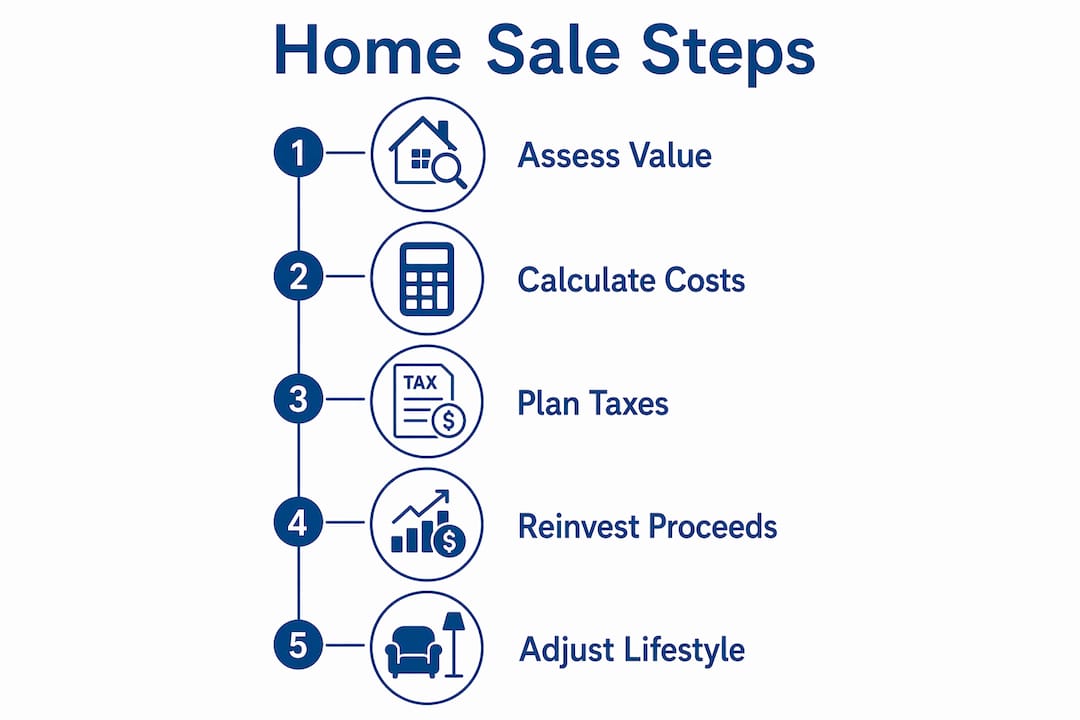
Downsizing feels like a straightforward win on paper. The reality is more complicated, and retirees who skip the math often end up disappointed.
Transaction costs eat into your proceeds
Real estate commissions run 5–6% of the sale price. On a $300,000 home, that is $15,000–$18,000 gone before you factor in closing costs, staging, repairs, or moving expenses. These costs are not optional, and they reduce the net proceeds available for reinvestment.
Here is a realistic cost breakdown for a typical retirement home sale:
- Real estate commission: 5–6% of sale price
- Closing costs (seller side): 1–3% of sale price
- Repairs and staging: Variable, often $2,000–$10,000
- Moving and storage: $1,000–$5,000 depending on distance
- Overlap costs: Rent or temporary housing if timing gaps occur
Hidden ongoing costs in your new home
Downsizing may not save money if your new home carries high HOA fees, elevated property taxes, or higher utility costs than expected. A condo in a desirable retirement community can carry HOA fees of $400–$700 per month. That annual cost of $4,800–$8,400 offsets a large portion of the savings from a smaller mortgage or no mortgage at all. Many retirees underestimate ongoing expenses in their new homes, which quietly erodes the financial benefit they expected from selling.
Pro Tip: Build a detailed “sell vs. stay” financial model before you list your home. Include net proceeds after all transaction costs, projected housing costs in the new location, tax implications, and the long-term portfolio impact of reinvesting the difference. Running this full financial model is the single most reliable way to avoid a costly surprise.
When is the right time to sell your home for retirement?
Timing a home sale for retirement purposes involves three separate clocks: the real estate market, your personal financial readiness, and your emotional readiness. All three need to align.
- Market conditions matter. Selling in a strong seller’s market can add tens of thousands of dollars to your net proceeds. Tracking local inventory levels, median days on market, and price trends in your area gives you a data-driven window for listing.
- Coordinate with your income transition. Selling the year you retire can create a tax planning opportunity. If your income drops significantly in your first retirement year, your capital gains may be taxed at a lower rate or fall entirely within the exclusion.
- Resolve title and legal issues early. Title problems and survey disputes are among the most common reasons home sales fall apart at closing. Ordering a title search and survey before you list gives you time to fix problems without losing a buyer.
- Factor in your next housing step. If you plan to buy another home, today’s mortgage rates affect your monthly payment significantly. Renting temporarily after selling can give you flexibility to shop without pressure. Retirees considering a move to another state should review Arizona relocation real estate considerations and similar regional guides before committing.
- Acknowledge emotional readiness. Selling a home you have lived in for 20 or 30 years is not purely a financial transaction. Giving yourself time to process the decision reduces the risk of regret or a rushed sale.
How does selling your home affect your retirement lifestyle?
The lifestyle impact of selling your home in retirement is real and often underestimated. Finances are only part of the picture.
Moving to a smaller home or a different community changes your daily life in ways that are hard to model in a spreadsheet. The benefits are genuine. A smaller home means less maintenance, lower utility bills, and fewer weekend hours spent on upkeep. Housing decisions directly affect lifestyle and social connections, including your sense of community and daily routine.
The trade-offs are equally real. You may leave behind neighbors you have known for decades, a yard your grandchildren love, or proximity to your doctor and favorite grocery store. These losses are not trivial. Retirees who relocate purely for financial reasons and ignore social factors report lower satisfaction in the years that follow.
Your housing options after selling include:
- Condos or townhomes. Lower maintenance, often in walkable areas, but HOA fees apply.
- Rental apartments. Maximum flexibility with no ownership risk, though you lose equity growth.
- Active adult communities (55+). Social programming and amenities built in, but costs vary widely.
- Moving closer to family. Prioritizes support networks over financial optimization, which is a valid and often underrated choice.
The right path depends on what you value most in retirement. Financial security and lifestyle satisfaction are not always the same destination. Understanding why selling before moving is hard helps you plan the logistics so the transition feels manageable rather than chaotic.
Key Takeaways
Selling your home in retirement is the second-largest financial transaction most retirees will manage, and the outcome depends entirely on how well you plan the tax strategy, cost structure, timing, and lifestyle transition together.
| Point | Details |
|---|---|
| Home equity is your largest asset | For most retirees, home equity makes up roughly 70% of net worth, making the sale decision critical. |
| Tax exclusions reduce your bill significantly | Married couples can exclude up to $500,000 in capital gains if they meet the IRS ownership and use tests. |
| Transaction costs reduce net proceeds | Commissions of 5–6% plus closing and moving costs can total $25,000 or more on a mid-range home. |
| Timing affects both price and taxes | Selling in your first retirement year can align with lower income and reduce capital gains tax exposure. |
| Lifestyle factors deserve equal weight | Social connections, community ties, and daily routines are as important as the financial math when choosing where to move. |
What I’ve learned from watching retirees navigate home sales
Selling a home requires as much intentional planning as managing a retirement investment portfolio. After working with retirees through this process, the pattern I see most often is not a bad decision. It is an incomplete one.
Retirees who struggle are usually the ones who focused on the sale price and ignored everything else. They did not model the HOA fees in the new condo. They did not account for the six months of overlap costs while waiting for the new place to be ready. They did not think through what it would feel like to leave a neighborhood they had lived in for 25 years.
The retirees who come out ahead treat the home sale as a coordinated financial move, not a standalone transaction. They work with a financial planner and a real estate professional at the same time. They run multiple scenarios. They give themselves enough runway to make the decision without pressure.
My honest advice: do not let the excitement of a strong sale price push you into a timeline that does not serve your actual retirement plan. The best home sale outcome is the one that fits your income needs, your tax situation, and the life you actually want to live. That takes more than a weekend of research. It takes a plan.
— Real Estate Team
Selling your home fast for retirement with Sell Dave Your House
Retirement timelines do not always allow for a six-month traditional listing process. If you need to access your home equity quickly to fund your next chapter, Sell Dave Your House offers a direct path. With over 16 years of experience in the Detroit market, Sell Dave Your House provides fair all-cash offers within 24 hours and can close in as little as seven days. You sell as-is, with no repairs, no agent commissions, and no hidden fees eating into your proceeds.

For retirees in the Detroit area who need speed and certainty, get a cash offer and see exactly what your home is worth without any obligation. If you are in the Harper Woods area, fast cash home options are available to help you move forward on your terms. Sell Dave Your House makes the process straightforward so you can focus on what comes next.
FAQ
What is the role of home sale in retirement planning?
Selling your home in retirement unlocks equity that can fund living expenses, generate investment income, or reduce financial pressure. For most retirees, it is the largest single source of liquidity outside of retirement accounts.
How much capital gains tax will I owe when I sell my home?
Single filers can exclude up to $250,000 in capital gains, and married couples filing jointly can exclude up to $500,000, provided they meet the IRS two-year ownership and use test. Gains above those limits are taxable.
Does downsizing actually save money in retirement?
Not always. Real estate commissions of 5–6%, moving costs, and ongoing HOA fees in a new home can offset much of the expected savings. Running a detailed financial model before selling is the most reliable way to know your true net benefit.
When is the best time to sell your home for retirement?
The best time aligns a strong seller’s market with your income transition year and your next housing step. Selling in a year when your taxable income drops can reduce or eliminate capital gains tax on proceeds above the exclusion limit.
Can I use home sale proceeds to boost my retirement income?
Yes. Reinvesting net proceeds into a diversified portfolio and applying a 4% withdrawal rate generates ongoing income. The larger the net proceeds, the more meaningful the annual income contribution from that reinvestment.
Recommended
- Sell a House for Retirement or Downsizing in Center Line, MI | Sell Dave Your House
- Sell a House for Retirement or Downsizing in Madison Heights, MI | Sell Dave Your House
- Sell a House for Retirement or Downsizing in Hazel Park, MI | Sell Dave Your House
- Sell a House for Retirement or Downsizing in Warren, MI | Sell Dave Your House