

Net proceeds from a home sale are the actual cash amount you receive after paying off your mortgage, agent commissions, closing costs, and all other sale-related expenses. This figure is almost always lower than your contract sale price, and many sellers overestimate what they will walk away with by focusing on the listing price alone. Understanding net proceeds, the industry term for your true cash outcome, is the most important financial calculation you will make before selling your home. Online home value estimators and net proceeds calculators can give you a useful starting point, but knowing the formula yourself puts you in control.
What is net proceeds from a home sale, and how does it differ from gross proceeds?
Net proceeds are the cash you keep after paying all sale-related costs, including your mortgage payoff, commissions, and closing costs. Gross proceeds, by contrast, are simply the agreed sale price before any deductions. The gap between the two numbers can be significant. On a $300,000 sale with a $200,000 mortgage balance and $25,000 in combined commissions and closing costs, your net proceeds would be roughly $75,000, not $300,000.
The distinction matters because your financial plans after closing, whether you are buying another home, paying off debt, or covering retirement expenses, depend entirely on the net figure. Gross proceeds tell you what a buyer paid. Net proceeds tell you what you actually received.

What costs are deducted from your home sale proceeds?
Every deduction below reduces the cash you take home at closing. Mortgage payoff is often the largest single deduction, and it frequently surprises sellers who have not checked their current balance recently.
Here are the most common deductions you will encounter:
- Mortgage payoff and liens. Your lender receives the full outstanding balance before you see a dollar. Any additional liens, such as a home equity line of credit or a judgment lien, are paid off at the same time.
- Agent commissions. Commissions commonly total 5% to 6% of the sale price, traditionally split between the seller's agent and the buyer's agent. Recent regulatory changes have shifted how these fees are disclosed and negotiated, so confirm the exact terms in your listing agreement before signing.
- Seller closing costs. Typical seller closing costs include title insurance, attorney fees, escrow fees, and transfer taxes, and they usually total 1% to 3% of the sale price. Amounts vary by state and transaction type.
- Seller credits. If you agreed to cover the buyer's repair requests or contribute to their closing costs, those credits come out of your proceeds at settlement.
- HOA transfer fees. Many homeowner associations charge a transfer fee when ownership changes hands. This cost is easy to overlook until closing day.
- Home warranty. Some sellers offer a one-year home warranty as a selling incentive. The premium is deducted from proceeds at closing.
How to calculate net proceeds from a home sale step by step
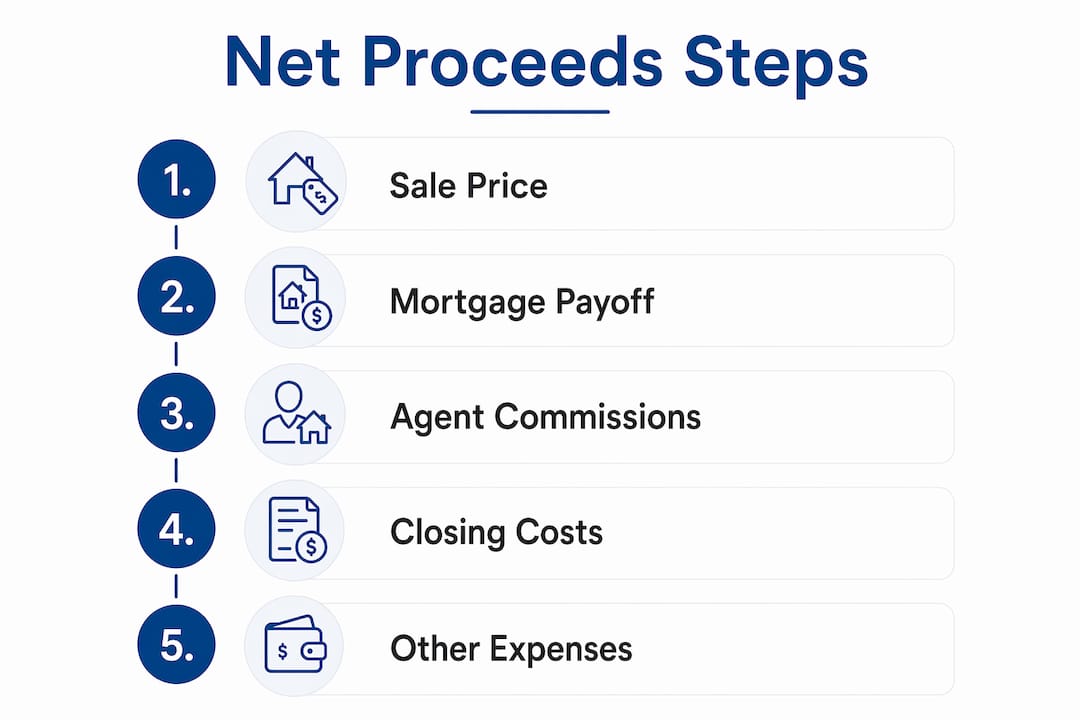
The core formula is straightforward: net proceeds = sale price minus mortgage payoff minus agent commissions minus closing costs minus other fees. Investopedia lists these as the major deductions every seller must account for. Running this calculation before you list gives you a realistic picture of your financial outcome.
Step-by-step calculation
- Start with your expected sale price. Use a recent comparative market analysis from your agent or an online estimator to set a realistic number.
- Subtract your mortgage payoff. Request the official payoff statement from your lender, not just your current balance.
- Subtract agent commissions. Multiply the sale price by your agreed commission rate, typically 5% to 6%.
- Subtract seller closing costs. Estimate 1% to 3% of the sale price for title, escrow, transfer taxes, and attorney fees.
- Subtract other fees. Add up seller credits, HOA transfer fees, staging costs, and any home warranty premiums.
- The result is your estimated net proceeds.
Example calculation
| Item | Amount |
|---|---|
| Sale price | $350,000 |
| Mortgage payoff | $210,000 |
| Agent commissions (5.5%) | $19,250 |
| Closing costs (2%) | $7,000 |
| Seller credit for repairs | $3,500 |
| Estimated net proceeds | $110,250 |
A seller net sheet formalizes this process. You start with the sale price and subtract each cost line by line to see exactly how cash changes with every deduction. Your agent can prepare one for you, or you can build your own using a spreadsheet.
Net proceeds vs. profit vs. capital gains: what is the difference?
These three terms describe three different things, and confusing them can lead to real financial surprises.
Net proceeds are the cash you physically receive after the sale closes. They account for your mortgage payoff, commissions, and closing costs, but they do not measure what you gained or lost on the investment itself.
Profit is a different calculation. Net proceeds differ from profit because profit accounts for your original purchase price and any capital improvements you made to the property. If you bought your home for $200,000, spent $30,000 on renovations, and received $110,250 in net proceeds, your profit is $110,250 minus $230,000, which is a loss on paper even though you walked away with cash.
Capital gains tax introduces a third layer. Capital gains are calculated on your gain, which is the sale price minus your adjusted basis and minus selling costs. Your mortgage payoff does not factor into the tax calculation at all. Paying off a $210,000 mortgage does not reduce your taxable gain because the mortgage is a debt you owe, not a cost of selling. This distinction catches many sellers off guard when they receive their tax documents.
The IRS Section 121 exclusion allows most homeowners to exclude up to $250,000 of capital gains ($500,000 for married couples filing jointly) if they have lived in the home as their primary residence for at least two of the past five years. Consult a tax professional to confirm whether you qualify before closing.
What challenges can affect your net proceeds calculation?
Not every sale produces a positive cash outcome. Net proceeds can be negative if your mortgage payoff and selling costs exceed the sale price. In that situation, you must either bring cash to the closing table or negotiate a short sale with your lender.
Watch for these common pitfalls:
- Underestimating the mortgage payoff. Accrued interest and prepayment penalties can push the payoff higher than expected.
- Ignoring seller credits. Buyers often request repair credits after the inspection. A $5,000 credit directly reduces your net proceeds.
- Forgetting HOA fees. Transfer fees and any unpaid HOA dues are collected at closing.
- Skipping staging and prep costs. Professional staging, deep cleaning, and minor repairs add up before the home even lists.
- Assuming the listing price equals the sale price. Negotiations, appraisal gaps, and market conditions routinely push final sale prices below the original ask.
If your early estimate shows net proceeds approaching zero, proactively contact your lender about your options before listing. A short sale requires lender approval and takes time to arrange. Waiting until closing day to discover a shortfall leaves you with almost no options. You can also review how selling your house for cash works to reduce commission costs and improve your net outcome.
Calculating net proceeds properly matters not just for budgeting but also for understanding your tax position correctly. Both goals require the same careful, line-by-line approach.
Key takeaways
Net proceeds are the actual cash a seller receives after deducting mortgage payoff, agent commissions, closing costs, and other fees from the gross sale price.
| Point | Details |
|---|---|
| Net proceeds vs. gross price | Net proceeds are always lower than the sale price once all deductions are applied. |
| Mortgage payoff is the biggest cut | Request the official payoff statement to get the accurate figure, not just your current balance. |
| Commissions and closing costs | Budget 5% to 6% for agent commissions and 1% to 3% for closing costs as a baseline estimate. |
| Net proceeds are not profit | Profit subtracts your original purchase price and improvements; net proceeds do not. |
| Negative proceeds are possible | If costs exceed the sale price, you owe money at closing or must pursue a short sale. |
What I have learned from watching sellers miscalculate their proceeds
Sellers consistently make the same mistake: they see the listing price and mentally spend it. I have watched homeowners plan a down payment on their next house, budget a kitchen renovation, or set aside retirement funds, all based on a number that does not survive contact with the closing statement.
The listing price is a marketing number. The net proceeds figure is the financial reality. Running a detailed seller net sheet before you list is not optional if you want to avoid a stressful surprise at closing. I recommend doing it at least 60 days before your target list date so you have time to adjust your plans or your pricing strategy.
The other thing sellers routinely underestimate is the emotional cost of discovering a shortfall late in the process. By the time you are two weeks from closing, you have already made commitments. Getting the math right early protects both your finances and your peace of mind. If your numbers are tight, consider selling your home for cash as a way to eliminate commission costs and get a guaranteed net figure upfront.
— Dave Joseph, Owner of Sell Dave Your House
How Sell Dave Your House makes your net proceeds clear from day one
Knowing your net proceeds before you commit to a sale is exactly what Sell Dave Your House delivers for Detroit area homeowners. When you request a cash offer, you receive a clear, all-in number with no agent commissions, no repair costs, and no surprise closing fees eating into your proceeds.

Sell Dave Your House has over 16 years of experience buying homes as-is across Detroit, Hazel Park, Harper Woods, Pontiac, and Grosse Pointe. The process is straightforward: you get a fair cash offer within 24 hours and can close in as little as seven days. For sellers who want certainty about what they will walk away with, that kind of transparency is worth a great deal.
FAQ
What is the basic formula for net proceeds from a home sale?
Net proceeds equal the sale price minus mortgage payoff, minus agent commissions, minus closing costs, and minus any other seller-paid fees. The result is the cash you receive at closing.
Are net proceeds the same as profit from selling a house?
No. Net proceeds are the cash you receive after paying sale-related costs. Profit is calculated by subtracting your original purchase price and capital improvements from your net proceeds.
Can net proceeds from a home sale be negative?
Yes. If your mortgage balance and selling costs exceed the sale price, your net proceeds are negative. You must bring cash to closing or negotiate a short sale with your lender.
Does mortgage payoff affect capital gains taxes?
No. The IRS calculates capital gains on your sale price minus your adjusted basis and selling costs. Your mortgage payoff is a debt repayment, not a selling cost, so it does not reduce your taxable gain.
How do I get the most accurate net proceeds estimate?
Request an official payoff statement from your lender, confirm your commission rate in writing, and get itemized closing cost estimates from your title company or attorney. A seller net sheet that lists every deduction gives you the clearest picture before closing.