

Why Selling an Inherited Home Differs: Detroit Guide
Selling an inherited home is fundamentally different from selling a house you bought yourself. The estate’s personal representative must hold legal authority under Michigan’s Estates and Protected Individuals Code (EPIC) before anyone can sign a contract, the IRS stepped-up basis rule resets your tax starting point to the home’s value at the date of death, and the timeline can stretch from weeks to well over a year depending on probate complexity. If speed and certainty matter most to you, Sell Dave Your House offers fair cash offers within 24 hours and can close in as little as seven days once estate documents are in order.
Three things heirs ask first:
- Who can legally sign? Only the court-appointed personal representative holding valid Letters of Authority can execute a sale contract on behalf of the estate.
- How do taxes work? Most heirs owe little or no capital gains tax because the stepped-up basis eliminates appreciation that built up before the date of death.
- How long does it take? A traditional listing on an inherited property often runs 9–18 months when probate is involved; a cash buyer can close in 7–21 days once authority and title are clear.
Table of Contents
- Why selling an inherited home differs: Michigan probate and title explained
- Tax rules that make inherited sales different from regular ones
- Family dynamics and estate debts that slow inherited sales
- Which selling route is right for your inherited property?
- How to prepare your inherited home for a fast cash sale
- Key Takeaways
- What the real estate team at Sell Dave Your House has seen in Detroit
- Sell Dave Your House makes inherited home sales straightforward in Detroit
- Useful sources for Michigan probate and inherited-property sales
- FAQ
Why selling an inherited home differs: Michigan probate and title explained
In Michigan, the estate’s personal representative must obtain Letters of Authority before a title company will close on an inherited property. That authority flows from the decedent’s will, a trust, or a court appointment under EPIC. Without it, no buyer’s lender or title company will proceed.
Most Michigan counties default to unsupervised (informal) administration, which means the personal representative can list and sell the property without seeking a judge’s approval at each step. That distinction matters practically: unsupervised administration can cut weeks or months off the timeline compared with supervised court-confirmed sales, where every major transaction requires a court order.
Title problems are the other common delay. Before a buyer will close, the title company will flag any of the following:
| Title / Lien Issue | Who Resolves It | Typical Impact on Closing |
|---|---|---|
| Outstanding mortgage balance | Paid from sale proceeds at closing | Minimal if payoff is documented |
| Unpaid property taxes | Estate or heir pays before or at closing | Can delay if amounts are disputed |
| Recorded judgments or liens | Estate attorney negotiates payoff | Days to weeks of added time |
| Unclear chain of title | Title company and probate attorney | Weeks to months |
To shorten legal delays, confirm the estate’s status early, obtain certified Letters of Authority, order a death-date title search, and coordinate with a title company that has handled probate closings before.
Pro Tip: When estate funds are thin, heirs sometimes advance carrying costs out of pocket. Keep a shared ledger of every payment, including taxes, utilities, and insurance, so the estate can reimburse you accurately from sale proceeds.
Tax rules that make inherited sales different from regular ones
Most heirs who sell shortly after inheriting owe little or no capital gains tax, and the reason is the stepped-up basis. Under IRS rules, your cost basis in an inherited home is reset to the property’s fair market value on the date of the decedent’s death, not what the original owner paid decades ago.
Here is what that means in practice. If your parent bought a Detroit home for $80,000 in 1985 and it was worth $280,000 at death, your basis is $280,000. Sell for $295,000 six months later and you owe capital gains tax on just $15,000, not the full $215,000 gain that accumulated over 40 years. Inherited property is also automatically treated as a long-term capital asset regardless of how briefly you held it, so any gain qualifies for the lower long-term rates.
The homeowner exclusion works differently. The standard $250,000/$500,000 exclusion requires you to have owned and lived in the home as your primary residence for at least two of the five years before the sale. Heirs who sell quickly almost never meet that test, but the stepped-up basis usually makes the exclusion unnecessary anyway.
Tax tasks to handle before closing:
- Order a date-of-death appraisal from a licensed appraiser ($300–$600 for most single-family homes) to document your basis.
- Keep receipts for any post-inheritance improvements, since those costs add to your basis and reduce taxable gain.
- Consult a CPA about whether the estate files Form 1041 or whether gains pass through to individual heirs on Schedule D.
- Confirm whether Michigan imposes any state-level tax on the sale proceeds for your specific situation.
Stepped-up basis quick reference: The IRS homeowner exclusion is $250,000 for single filers and $500,000 for married couples filing jointly, but it requires two years of personal occupancy. Most heirs selling quickly rely on the stepped-up basis instead, which typically reduces the taxable gain to near zero.
Family dynamics and estate debts that slow inherited sales
Family disagreements and unresolved estate debts typically slow inherited sales more than obscure legal rules. When multiple heirs inherit a property, every co-owner must agree on price, repairs, and timing before a sale can close. One heir may want to sell immediately; another may feel emotionally attached or want to rent the property instead. Those competing priorities stall negotiations and, in the worst cases, lead to costly partition lawsuits.

Estate debts add another layer. Outstanding mortgages, liens, funeral expenses, and medical bills may need to be settled or structured as payoffs at closing before the title transfers cleanly. If the estate lacks liquid funds, heirs sometimes need to coordinate a buyout or agree to cover costs temporarily.
Pro Tip: Get a written agreement among all heirs as early as possible. Practitioners consistently recommend this to prevent court-ordered interventions that drag out timelines and legal costs.
“Family dynamics often complicate inherited sales more than strict legal rules. A clear, written agreement among heirs and a single designated point-person reduce delays and the risk of court intervention significantly.” — Gudeman & Associates, P.C.
If heirs cannot agree, mediation is a faster and far less expensive path than a partition action. Appoint one lead heir to handle communications with the title company, attorney, and any buyers. Use a shared estate inventory and ledger so every decision and expense is documented and transparent.
Which selling route is right for your inherited property?
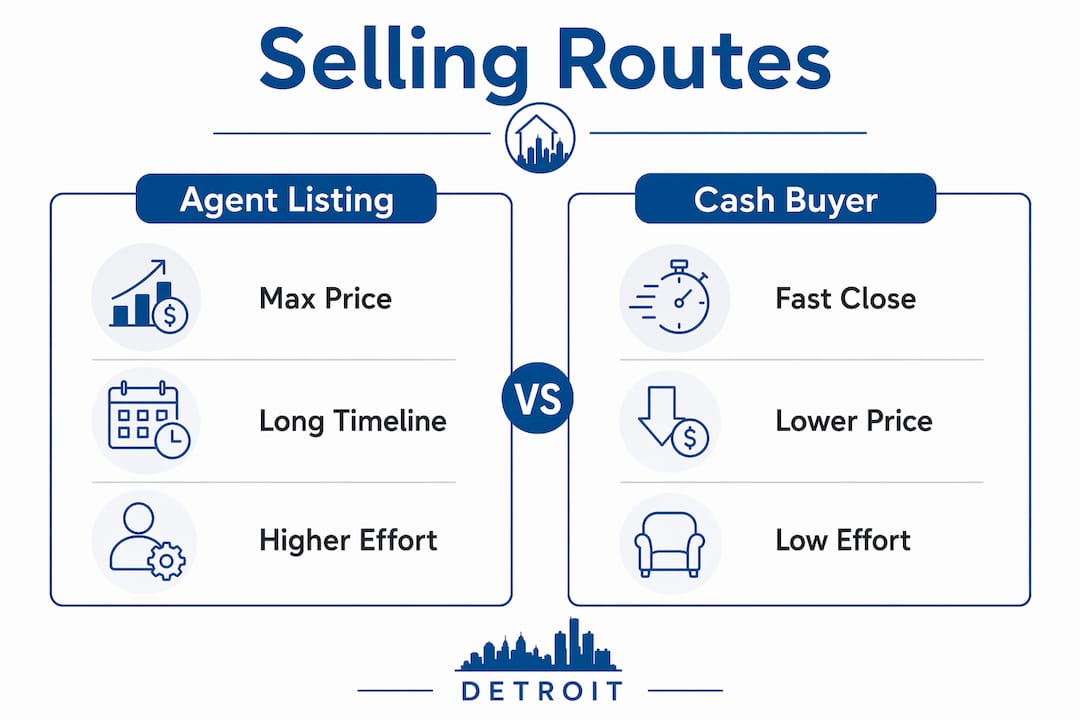
For heirs prioritizing speed and certainty, as-is cash buyers shorten timelines dramatically. Agent listings can maximize price but take longer and carry fees that reduce net proceeds.
| Selling Route | Typical Timeline | Net Proceeds | Seller Effort | Certainty |
|---|---|---|---|---|
| Agent listing | Several weeks to months to contract; longer with probate | Highest (minus typical commission and costs) | High | Moderate |
| Probate court-confirmed sale | Adds weeks to months for court approval | Moderate | High | Lower |
| Auction | — | Variable, often below market | Low | Moderate |
| Family buyout | Varies by negotiation | Negotiated | Moderate | High if agreed |
| As-is cash buyer | 7 days to as much as 21 days once documents and title are clear | Below top market; no repair/commission costs | Low | Highest |
When the estate is under supervised administration, a court-confirmed sale is required. That process adds an overbidding period and a court hearing before closing, which can push timelines out by several additional months and limits the buyer pool to those willing to wait.
How to prepare your inherited home for a fast cash sale
If speed and certainty are your priorities, gather these documents and complete these tasks now so a cash buyer can close without delays.
Documents to collect:
- Certified death certificate
- Letters Testamentary or Letters of Authority (certified copies)
- Copy of the will or trust
- Title search results or prior title insurance policy
- Recent mortgage statement showing payoff balance
- Property tax payment history
- Keys and access information for all entry points
Property tasks for an as-is cash sale:
- Secure the property and change locks if needed.
- Remove personal valuables and family belongings.
- Document the home’s condition with dated photos.
- Provide any available inspection reports, utility bills, or repair records.
Questions to ask a cash buyer before signing:
- Do you purchase homes that are still in probate?
- How do you handle existing liens or unpaid taxes?
- What is your typical closing window once estate documents are verified?
- Will you accept the property as-is without requiring repairs?
First 7–21 days action plan:
- Confirm the personal representative’s authority and obtain certified Letters of Authority.
- Order a death-date title search through a local title company.
- Get a date-of-death appraisal from a licensed appraiser.
- Contact at least one cash buyer and one probate-aware real estate agent for comparison.
- Gather all documents listed above and share them with your estate attorney.
Key Takeaways
Selling an inherited home in Detroit requires legal authority, a stepped-up basis valuation, and a clear plan among heirs before any sale can close efficiently.
| Point | Details |
|---|---|
| Legal authority first | Only a personal representative with Letters of Authority can legally sell estate real estate in Michigan. |
| Stepped-up basis reduces taxes | Your tax basis resets to the home’s date-of-death value, often eliminating most capital gains for heirs who sell quickly. |
| Timeline varies widely | Traditional inherited sales often take many months with probate; cash buyers can close in a matter of days to a few weeks once documents are ready. |
| Written heir agreement matters | A signed agreement among all heirs prevents disputes that stall sales and trigger costly legal intervention. |
| Sell Dave Your House | Offers fair cash offers within 24 hours and closes in as little as seven days for Detroit heirs selling as-is. |
What the real estate team at Sell Dave Your House has seen in Detroit
Over 16 years of closing inherited-property deals in Detroit, the team at Sell Dave Your House has seen the same pattern repeat: heirs who get their paperwork in order early close fast and walk away with certainty. Those who wait, hoping the market will move or that a family disagreement will resolve itself, often spend months paying carrying costs on a property they never wanted to own.
The most common misconception is that probate automatically means a long wait. When the estate is under unsupervised administration and the personal representative has certified Letters of Authority, a cash sale can move from offer to closing in a matter of days, not months. Sell Dave Your House coordinates directly with title companies and estate attorneys to verify authority and clear liens, so heirs do not have to manage that process alone.
A typical Detroit inherited-home cash sale with Sell Dave Your House looks like this: a cash offer arrives within 24 hours of the initial contact, and closing happens in as little as seven days once estate documents and title are confirmed. No repairs, no agent commissions, no open houses.
Sell Dave Your House makes inherited home sales straightforward in Detroit
Heirs in Detroit who want to skip repairs, agent fees, and months of uncertainty have a direct path forward with Sell Dave Your House. The process is built around the realities of inherited sales: no condition requirements, no commission deductions, and closing dates that work around estate administration timelines.

With more than 16 years of experience buying homes across Detroit and the surrounding area, Sell Dave Your House understands how to work within Michigan probate requirements. The team reviews your Letters of Authority, coordinates with your title company, and deposits proceeds directly to the estate account or distributes them per estate instructions. If the inherited property carries a mortgage or liens, those get resolved at closing from the sale proceeds so you do not have to arrange separate payoffs.
If you are ready to see what a fair cash offer looks like for your inherited Detroit property, request a cash offer today. You can also review the full reasons to sell fast to confirm this is the right path for your situation.
This article provides general information about selling inherited property and is not legal, tax, or financial advice. Confirm current Michigan probate rules and IRS requirements with a qualified attorney or CPA before closing.
Useful sources for Michigan probate and inherited-property sales
| Source | Best For |
|---|---|
| IRS Publication 551 | Official stepped-up basis rules and consistent basis requirements |
| IRS Gifts & Inheritances FAQ | How to report inherited property sales on Schedule D |
| Nolo: Homeowner Exclusion for Heirs | Whether the $250,000/$500,000 exclusion applies to your situation |
| Redfin: Selling an Inherited House | Practical step-by-step guide including appraisal and expense documentation |
| Houzeo: Selling Inherited Property | Cash buyer trade-offs and timeline comparisons |
| Gudeman & Associates | Michigan-specific legal guidance on heir agreements and probate |
| BBA Law: Michigan Probate Real Estate Guide | County-by-county breakdown of supervised vs. unsupervised administration |
FAQ
Who has legal authority to sell an inherited home in Michigan?
The estate’s personal representative, appointed by the court or named in the will, must hold valid Letters of Authority under Michigan’s EPIC before signing any sale contract.
Will I owe capital gains tax when I sell an inherited house?
Most heirs owe little or no capital gains tax because the stepped-up basis resets the cost basis to the home’s fair market value at the date of death, leaving only post-death appreciation taxable.
How long does selling an inherited home in Detroit typically take?
Traditional inherited sales with probate often run 9–18 months, while a cash buyer like Sell Dave Your House can close in as little as 7 days, sometimes up to 21 days depending on how quickly documents and title are verified.
Does the $250,000/$500,000 homeowner exclusion apply to inherited homes?
Only if you lived in the inherited home as your primary residence for at least two years. Most heirs selling quickly do not qualify, but the stepped-up basis usually eliminates most of the gain anyway.
Can I sell an inherited home as-is without making repairs?
Yes. Cash buyers accept inherited properties in any condition and do not require repairs, inspections, or cosmetic updates before closing.