

Selling your home without a real estate agent, known in the industry as For Sale By Owner or FSBO, means you handle every step of the transaction yourself to avoid paying a listing agent's commission. That commission typically runs 2.5% to 3% of the sale price, which on a $400,000 home equals roughly $12,000 kept in your pocket. The tradeoff is real: you take on pricing, marketing, negotiation, legal disclosures, and closing coordination entirely on your own. Tools like a real estate attorney, a title company, and flat fee MLS services become your support system when you sell a house without a Realtor.
What do you need before you can sell your home without an agent?
Preparation is the single biggest factor separating a smooth FSBO sale from a costly one. Before you list, you need three things in place: an accurate price, a legal team, and a marketing plan.
Pricing your home correctly
Pricing too high stalls your listing. Pricing too low leaves money on the table. Pull recent comparable sales, called “comps,” from public county records or free tools like Zillow and Redfin. A licensed appraiser can also give you a formal opinion of value for a few hundred dollars. That cost is worth it because FSBO homes sell for roughly $65,000 less on median than agent-assisted homes. Accurate pricing from the start closes that gap significantly.

Legal and closing professionals you need
Real estate contracts and disclosures are complex, and errors in either can expose you to lawsuits after closing. Hire a real estate attorney before you list, not after you receive an offer. Attorney involvement is beneficial even in states where it is not legally required, because disclosure obligations and contract language vary by state. A title company or escrow agent handles the actual closing, verifies the title is clear, and distributes funds correctly.
Here is a checklist of documents you will need to gather:
- Seller's disclosure statement
- Property deed
- Recent mortgage payoff statement
- HOA documents (if applicable)
- Survey or plat map
- Utility bills and property tax records
- Purchase and sale agreement (prepared by your attorney)
Marketing channels for FSBO sellers
Flat fee MLS services let you list your home on the Multiple Listing Service without hiring a full agent. That MLS exposure feeds Realtor.com, Zillow, and Trulia automatically. You still manage all showings, inquiries, and negotiations yourself. Supplement MLS with social media posts, yard signs, and direct outreach to your neighborhood network.
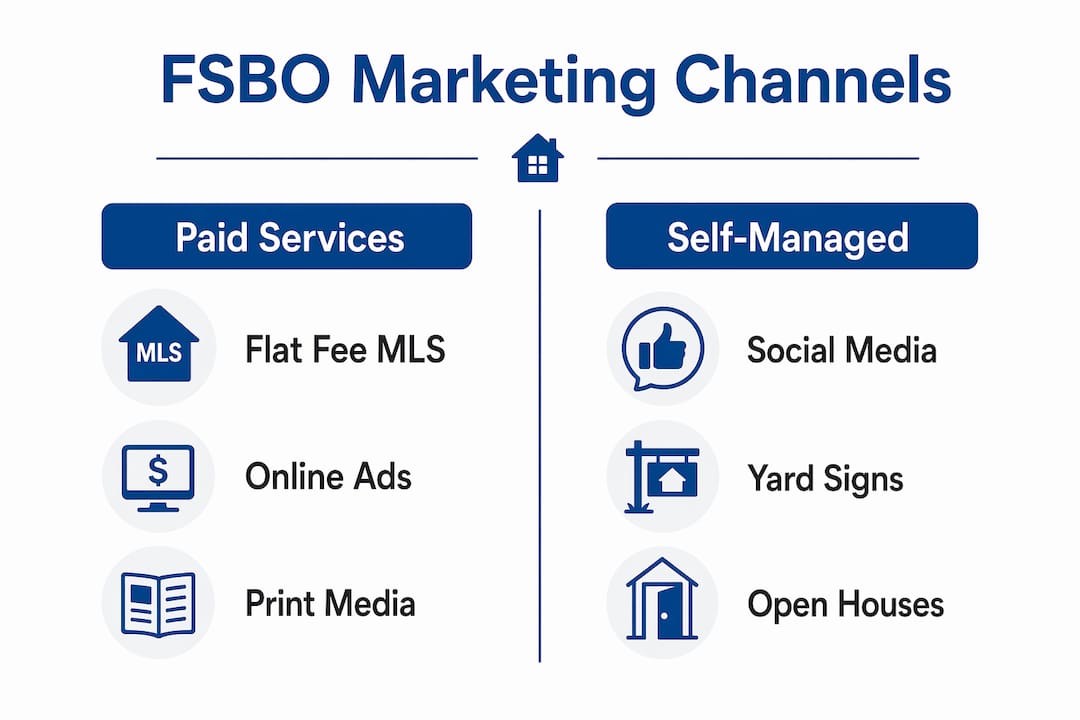
| Marketing channel | Cost range | What you manage |
|---|---|---|
| Flat fee MLS service | $100 to $500 | All showings and inquiries |
| Zillow “For Sale By Owner” | Free | Listing updates and buyer contact |
| Social media (Facebook Marketplace) | Free | Messaging and scheduling |
| Yard sign | Under $50 | Directing foot traffic |
| Real estate attorney | Varies by state | Contracts and disclosures |
How to sell your house privately: a step-by-step process
Selling property on your own follows a clear sequence. Skipping steps creates problems at closing.
- Prepare the home. Deep clean, declutter, and make minor repairs. Fresh paint and clean landscaping improve first impressions without major cost. Consider a professional photographer because listing photos directly affect how many buyers schedule showings.
- Set your price. Use comps, an appraisal, or both. Price within 2% to 3% of your target to leave room for negotiation without starting too far off market value.
- List on MLS and other platforms. Use a flat fee MLS service and post on Zillow's FSBO section and Facebook Marketplace simultaneously. The more exposure, the faster qualified buyers find you.
- Field inquiries and schedule showings. Respond to every inquiry within a few hours. Slow responses signal disorganization and push buyers toward other listings. Be flexible with showing times, including evenings and weekends.
- Review and negotiate offers. Read every offer carefully with your attorney. Look beyond the price: review contingencies, closing timeline, and financing type. Counter offers are normal. Your attorney drafts or reviews all written responses.
- Collect earnest money. Earnest money deposits typically run 1% to 3% of the sale price and must be held in escrow by a title company or attorney, not by you personally. This deposit shows the buyer is serious and protects you if they back out without cause.
- Coordinate closing. Your title company orders a title search, clears any liens, and prepares closing documents. Your attorney reviews the settlement statement. You sign, the buyer signs, and funds are transferred.
How do you qualify buyers and handle offers without an agent?
Buyer qualification protects you from wasted time and failed closings. Request a mortgage preapproval letter from every financed buyer before you accept an offer. A preapproval letter is different from a prequalification. Preapproval means a lender has verified the buyer's income, credit, and assets. Prequalification is just a self-reported estimate.
When reviewing offers, pay attention to these factors:
- Loan type. Conventional loans close faster than FHA or VA loans, which require additional inspections and appraisals.
- Down payment size. A larger down payment signals financial strength and reduces the risk of the deal falling apart during underwriting.
- Contingencies. Financing contingencies, inspection contingencies, and appraisal contingencies all give buyers legal exits. Fewer contingencies mean a cleaner deal.
- Closing timeline. Match the buyer's proposed closing date to your own move-out plans. Misaligned timelines create stress and potential costs.
- Cash buyers. Cash offers skip the mortgage process entirely. They close faster and carry fewer contingencies, which is why many sellers prefer cash buyers when speed matters.
Never accept a verbal offer. Every negotiated term must be in writing, reviewed by your attorney, and signed by both parties before it is binding.
What are the biggest FSBO mistakes and how do you avoid them?
Only about 5% of U.S. home sales are FSBO. That low number reflects the real difficulty of the process, not just a preference for agents. Understanding the most common mistakes helps you avoid them.
“The main financial advantage to FSBO is avoiding the listing agent commission, but the seller must take on significant responsibilities to succeed.” — Dave Joseph, Owner of Sell Dave Your House
Overpricing the home. Sellers often attach emotional value to their property that buyers do not share. An overpriced listing sits on the market, and a stale listing signals problems to buyers even when none exist. Price based on data, not sentiment.
Skipping legal review. Contract errors and missing disclosures are the most expensive mistakes in FSBO sales. A single omission can trigger post-closing litigation. Your attorney's fee is far cheaper than a lawsuit.
Underestimating time demands. FSBO sellers handle all agent responsibilities themselves, including pricing, marketing, showing, negotiating, and paperwork. That workload is significant, especially if you are working full time or managing a difficult personal situation.
Accepting unqualified buyers. A buyer without verified financing can tie up your home for weeks before the deal collapses. Always verify preapproval before accepting any offer.
For homeowners who want to sell a house in disrepair, the FSBO process adds another layer of complexity because buyers and their lenders may require repairs before closing. Knowing this upfront helps you set realistic expectations.
Key takeaways
Selling your home without a real estate agent saves on commission fees but requires you to manage pricing, marketing, legal documents, and buyer qualification with the same care a professional would apply.
| Point | Details |
|---|---|
| Commission savings are real but conditional | Saving 2.5% to 3% in agent fees only pays off if you price and market the home correctly. |
| Legal help is non-negotiable | Hire a real estate attorney before listing to handle contracts, disclosures, and closing documents. |
| Buyer qualification protects your deal | Always request a mortgage preapproval letter before accepting any financed offer. |
| Earnest money goes into escrow | Deposits of 1% to 3% must be held by a title company or attorney, not the seller. |
| FSBO homes often sell for less | The median FSBO sale price is roughly $65,000 lower than agent-assisted sales, so pricing accuracy is critical. |
My honest take on FSBO after years in Detroit real estate
FSBO works best for a specific type of seller: someone with time, organization skills, and at least a basic understanding of real estate contracts. I have seen homeowners pull it off successfully, and I have seen others lose more in pricing errors and legal fees than they ever would have paid in commission.
The piece most sellers underestimate is the closing team. A good real estate attorney and a reliable title company are not optional extras. They are the foundation of a successful FSBO sale. Without them, you are exposed to contract disputes, title defects, and disclosure claims that can follow you for years after the sale.
State-specific rules add another layer of complexity. Michigan, for example, has its own disclosure requirements and closing customs that differ from Florida or Texas. What works in one state may not be legal or standard in another. If you are selling in Detroit or anywhere in Michigan, get local legal counsel, not generic online templates.
The honest truth is that FSBO is not for everyone, and there is no shame in that. If you are facing a time-sensitive situation, a property that needs work, or a financial hardship that makes a long listing period risky, the commission savings may not be worth the stress and uncertainty. Knowing your limits is not a weakness. It is good judgment.
— Dave Joseph, Owner of Sell Dave Your House
A faster alternative when FSBO is not the right fit
Not every homeowner has the time or bandwidth to manage a full FSBO sale. If you are dealing with financial pressure, an inherited property, or a home that needs repairs, a cash offer may be the more practical path.

Sell Dave Your House has worked with Detroit homeowners for over 16 years, providing fair all-cash offers within 24 hours and closing in as little as seven days. There are no agent commissions, no repair requirements, and no showings to coordinate. You sell the home as-is and walk away with cash. If that sounds like a better fit for your situation, see how it works and get a no-obligation offer today.
FAQ
What does FSBO mean in real estate?
FSBO stands for For Sale By Owner. It means the homeowner sells the property without hiring a listing agent, handling all pricing, marketing, and negotiation independently.
How much can you save by selling without an agent?
Avoiding the listing agent commission saves roughly 2.5% to 3% of the sale price. On a $400,000 home, that equals approximately $12,000 in savings.
Do you need a lawyer to sell your home without an agent?
A real estate attorney is not legally required in every state, but hiring one is strongly recommended. Attorneys prepare contracts, review disclosures, and manage closing documents to protect you from post-sale legal disputes.
Why do FSBO homes sell for less than agent-listed homes?
The median FSBO sale price is roughly $65,000 lower than agent-assisted sales, largely because FSBO sellers often price incorrectly and have less marketing reach. Accurate pricing and MLS exposure close much of that gap.
What is earnest money and who holds it?
Earnest money is a deposit, typically 1% to 3% of the sale price, that a buyer submits with their offer to show commitment. It must be held in escrow by a title company or attorney until closing, not by the seller directly.